TL;DR
In 2026, you’re juggling new CX platforms, AI agents, unified commerce, loyalty redesign, and store digitization. The tech isn’t the hardest part anymore. Getting people to actually change how they work is.
That’s why change management in retail matters more than ever. Many retailers see pilot success, then full rollout disappointment. This guide gives you a practical, retail-specific framework to make customer-centric and digital transformation stick across your business.
What is change management in retail?
Change management in retail is the structured way you plan, communicate, execute, and sustain changes to how people work across stores, e-commerce, and HQ so new strategies and technology deliver real results.
This isn’t abstract organizational theory.
You’re trying to manage change inside a fast-moving retail organization with store operations, seasonal staff, digital teams, and head office all working in different systems.
You’re aligning people, processes, and tools so transformation doesn’t stall after launch.
When you’re shifting toward a stronger omnichannel e-commerce strategy or trying to improve loyalty and customer experience at scale, structured change management becomes critical. Without it, even the right technology won’t deliver the benefits you expect.
Typical change scenarios retailers face in 2026
In 2026, most retail leaders aren’t asking if they need change. They’re already in the middle of it.
Here are common examples you might recognize:
Implementing a new CX or loyalty platform
You’re rolling out a new system like Voyado to replace separate systems for email, loyalty, and customer data. The pilot works. But full adoption across teams is slow.
Moving from channel-centric to omnichannel and agentic AI
You shift from siloed campaigns to a true omnichannel retail strategy. That means new processes, new skills, and new decision-making powered by data instead of instinct.
Replatforming e-commerce or POS
You introduce a new system and try to connect online and store journeys. Suddenly, store operations and digital teams must coordinate in ways they never have before.
Redesigning loyalty programs
You move from discount-led programs to engagement-driven strategies focused on customer experience and growth. That requires cultural shifts and stakeholder engagement across marketing and store teams.
Changing store roles
Store employees shift from purely transactional tasks to experience and relationship-building. That means training, communication, and strong leadership support.
Each of these transformation projects looks different.
But they share the same pattern: technology changes fast. People change more slowly because everyone can agree that change is hard.
Why change management is uniquely hard in retail
Change management in retail sounds simple on paper.
In reality, it collides with daily pressure, tight margins, and constant operational noise.
The retail industry has structural challenges that make organizational change harder than in most businesses. If you don’t account for them, even strong transformation projects lose momentum.
Here’s what you’re really up against.
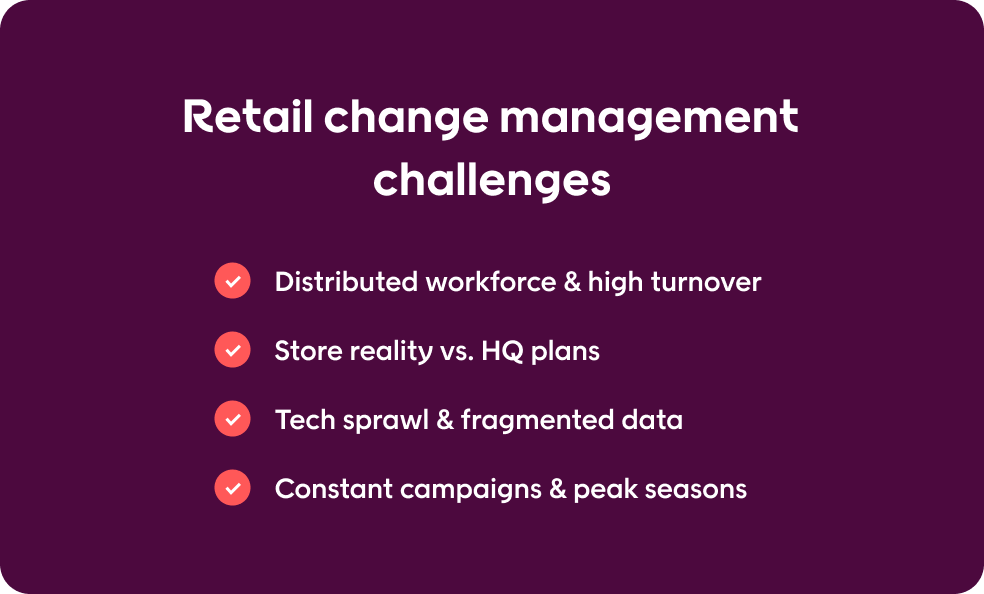
Distributed workforce and high turnover
You’re leading change across a distributed retail organization:
- Multiple stores and markets
- Franchise partners
- Full-time, part-time, seasonal, and student employees
Driving consistent communication, training, and support across that mix is hard. High turnover means you’re not implementing a new system once. You’re onboarding continuously.
If you’re trying to improve retail CX, everyone needs to understand the shift, not just HQ.
This is where structured change management becomes critical. Without it, adoption becomes uneven.
Store reality vs HQ PowerPoints
At HQ, you design new processes.
In store operations, teams handle queues, staffing gaps, and stock issues.
If a new system adds friction, resistance isn’t about being against change. It’s about protecting time and customers.
Rolling out a CX or loyalty platform may look efficient centrally. But if it doesn’t integrate smoothly with existing tools, it creates extra workload.
Effective change management means involving stakeholder groups early and running a real impact assessment. That’s especially true when shifting toward multichannel retailing. Strategy must translate into something practical on the floor.
Tech sprawl and data fragmentation
Most retailers operate with separate systems for email, SMS, e-commerce, analytics, and loyalty.
Change rarely means replacing one tool.
It means connecting systems and aligning business processes.
That adds complexity, IT dependency, and risk. It also demands stakeholder engagement across marketing, CX, and digital teams.
When you move toward unified platforms or deeper personalization, like those discussed in personalization in retail, you’re reshaping decision-making and data flows across the organization.
That’s a substantial change, not a simple upgrade.
Constant promotions and peak seasons
Retail never pauses.
There’s always:
- The next campaign
- The next launch
- The next peak season
If a change initiative isn’t planned around key moments, it gets pushed or half-done.
That’s why change management in retail is about timing as much as strategy. Your structured approach must reflect inventory planning cycles, promotional calendars, and real resource constraints.
You’re not managing change in a vacuum. You’re managing it in motion.
And that’s exactly why you need a clear, practical framework.
5 core pillars of effective change management in retail
If change management in retail feels chaotic, it’s usually because there’s no clear backbone behind it.
These five pillars give you a structured approach. Use them to guide your next transformation and keep it grounded in retail reality.
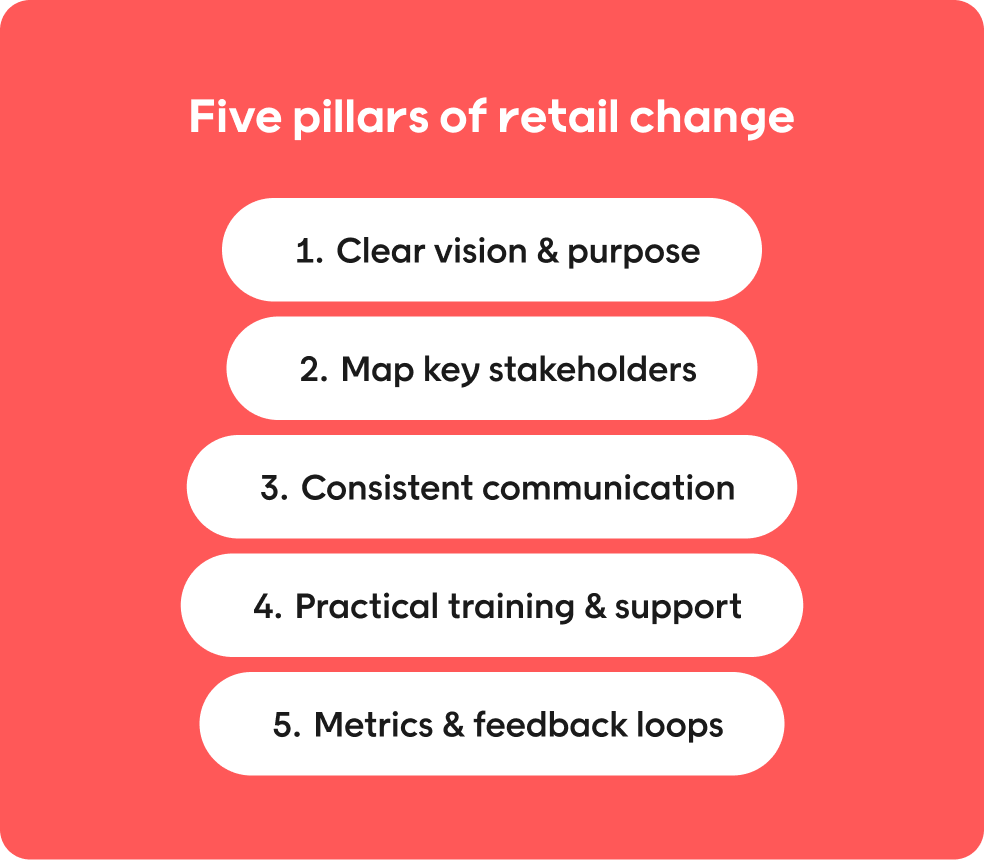
1. Clear vision and a simple why for everyone
Strategy language does not change behavior. Clarity does.
If you’re introducing unified platforms or expanding into areas like retail-media, explain what that actually means for daily work.
Translate the vision into practical outcomes:
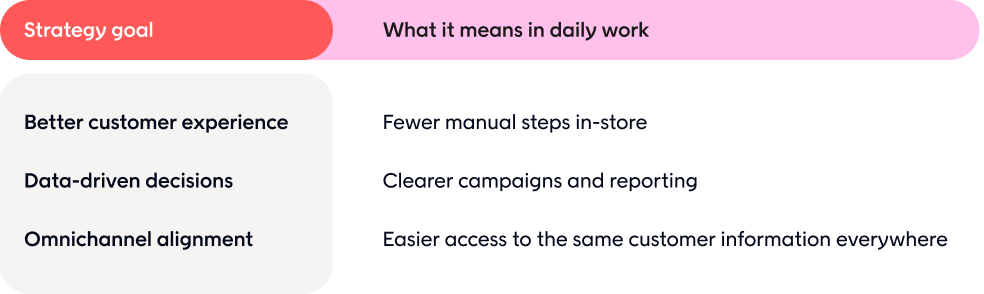
When leaders communicate this clearly, teams are more likely to gain support and buy-in. That’s one of the key elements of effective change management.
Clarity sets direction. Alignment makes it real.
2. Stakeholder mapping from HQ to store floor
Every transformation touches different stakeholder groups.
Instead of sending one broad message, map influence and impact first.
At the top: executive sponsors who set priorities.
In the middle: marketing, CRM, e-commerce, CX, and IT.
On the ground: regional leads, store managers, frontline champions.
Ask two questions:
- Who is directly impacted by the new system or new processes?
- Who can influence adoption inside the retail organization?
This is where structured change management prevents confusion. Clear ownership improves decision-making and strengthens stakeholder engagement across teams.
Once roles are defined, communication becomes targeted instead of generic.
3. Communication that feels like a story
Retail teams do not need more instructions. They need context.
Your communication should answer three things consistently:
- What is changing
- What stays the same
- What is expected from me
If you’re connecting physical and digital journeys, show how insights from retail location analytics improve customer experience in real terms.
Instead of abstract slides, use simple before-and-after visuals. Show how workflows improve. Show how customers benefit.
Consistent communication reduces resistance and reinforces why change management is important in retail, which is about clarity, not just technology.
Now that people understand the change, you need to equip them.
4. Training, enablement, and in-store support
Training must match store reality.
Rather than one long session, use layered enablement:
- Short, role-based videos
- Scenario walkthroughs
- In-tool guidance
- Quick-reference material for busy shifts
Make it specific. For example, how to handle a loyalty question in-store using a new system.
Then plan a short hyper-care period after go-live. Dedicated support in the first weeks builds confidence and protects store operations.
When employees feel supported, adoption accelerates. That’s critical for long-term success.
Understanding builds confidence. Measurement builds momentum.
5. Metrics, feedback loops, and continuous improvement
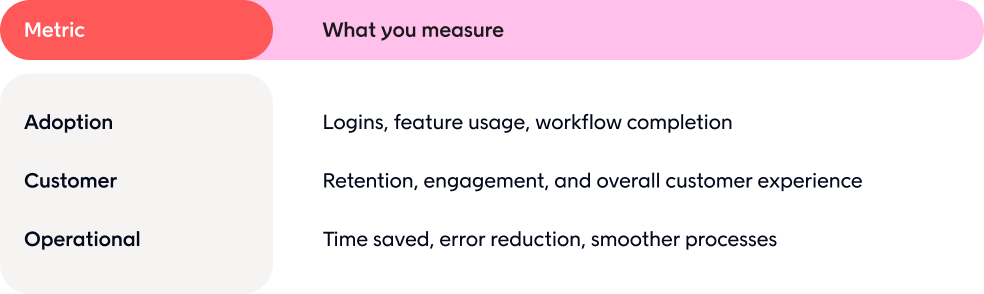
Define success before you launch.
Think in three layers:
Then close the loop.
Gathering feedback from store teams and central functions gives you valuable insights. Use that data to refine processes, improve training, and adjust workflows.
Effective change management is not one event. It’s continuous development inside your organization.
When you measure, adjust, and communicate results, transformation becomes sustainable. And that’s how change management in retail shifts from a project to a long-term capability.
A step-by-step approach to change management in retail
The pillars give you the foundation.
Now let’s turn that into a practical playbook.
Think of this as a structured approach you can adapt to any change initiative, whether you’re introducing a new system, launching unified platforms, or redesigning customer journeys.
Keep it simple. Move step by step.
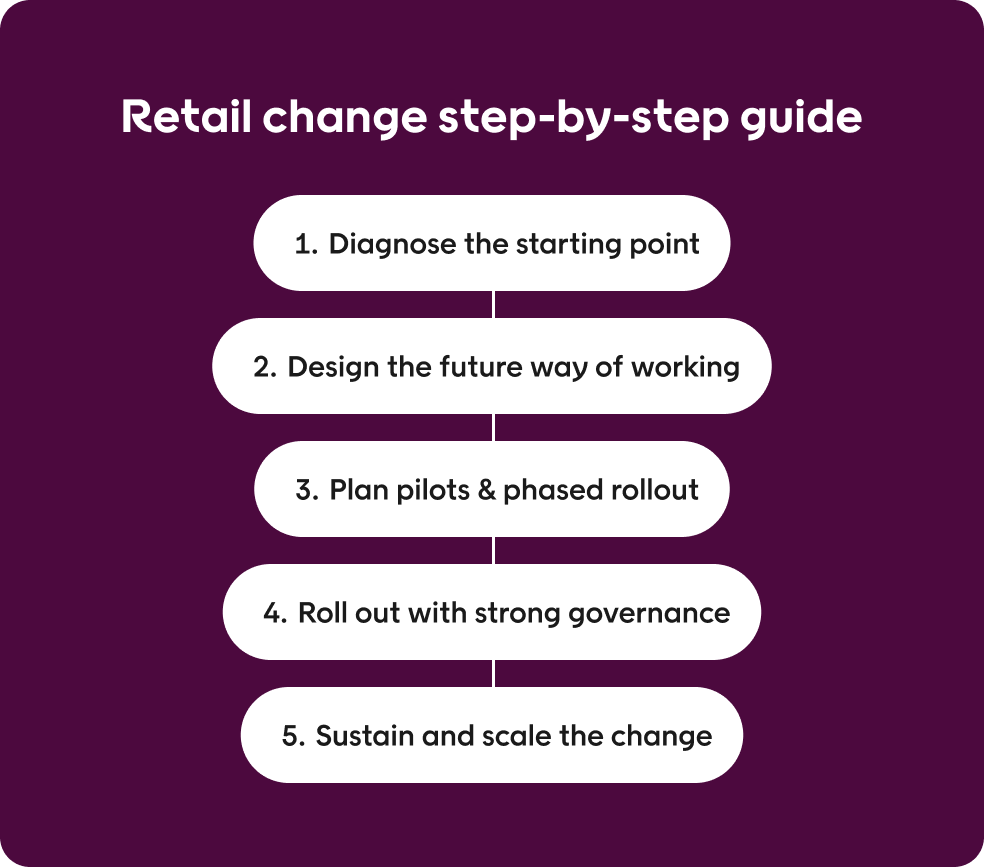
Step 1: Diagnose the starting point
Before you design anything new, understand where you are.
Start with three questions:
- What is driving this change? A new CX platform, an agentic AI initiative, omnichannel orchestration?
- What already works well in your retail organization?
- Where do things repeatedly fail?
Then look at sentiment.
Which teams are enthusiastic?
Which are skeptical?
This early impact assessment helps you anticipate resistance and focus your support where it’s needed most.
Effective change management begins with clarity, not assumptions.
Once you know the starting point, you can design the destination.
Step 2: Design the future way of working
Do not start with features. Start with journeys.
Map two views side by side:
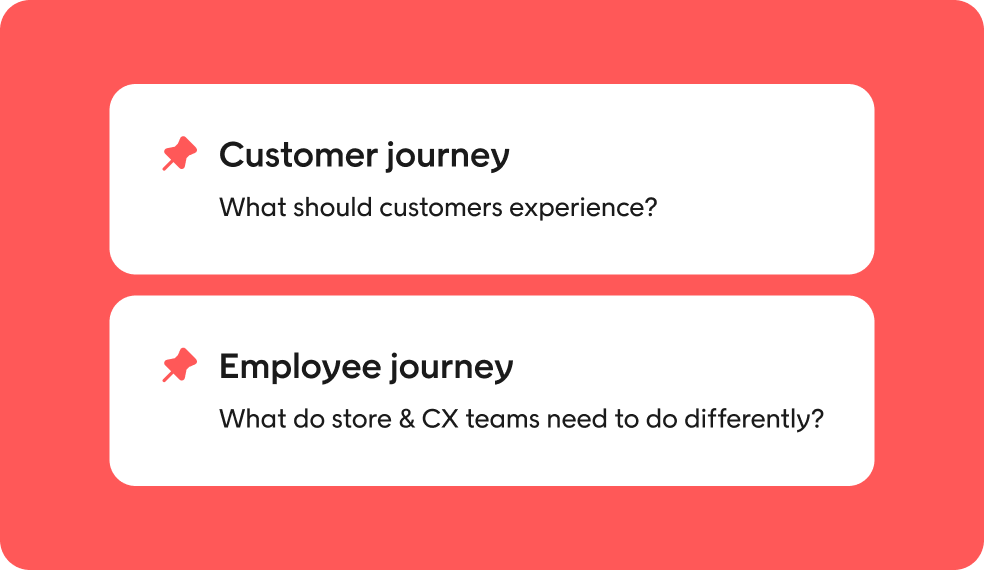
This forces alignment between customer experience and internal business processes.
Then define:
- Roles and responsibilities
- New processes
- Where new tools fit into your existing system landscape
If you’re onboarding something like Voyado, be explicit about how it integrates with your other tools and how it supports decision-making across marketing and store operations.
This is where structured change management becomes practical. You are designing behavior, not just configuring technology.
Once the future state is clear, test it.
Step 3: Plan pilots and phased rollout
Avoid going market-wide on day one. You need to select a pilot group:
- A few markets
- A cluster of representative stores
- One brand or segment
Test more than the system.
You’ll need to test new journeys, communication flows, and other training formats.
Gathering feedback during this phase gives you valuable insights before scaling. It also builds credibility across stakeholder groups.
Use pilot learnings to refine processes, adjust training, and resolve pain points.
Then set a clear decision point. Roll out, pivot, or stop.
Pilots are a tool, not a hiding place.
Step 4: Roll out with strong governance
Full rollout requires discipline.
Define governance clearly:
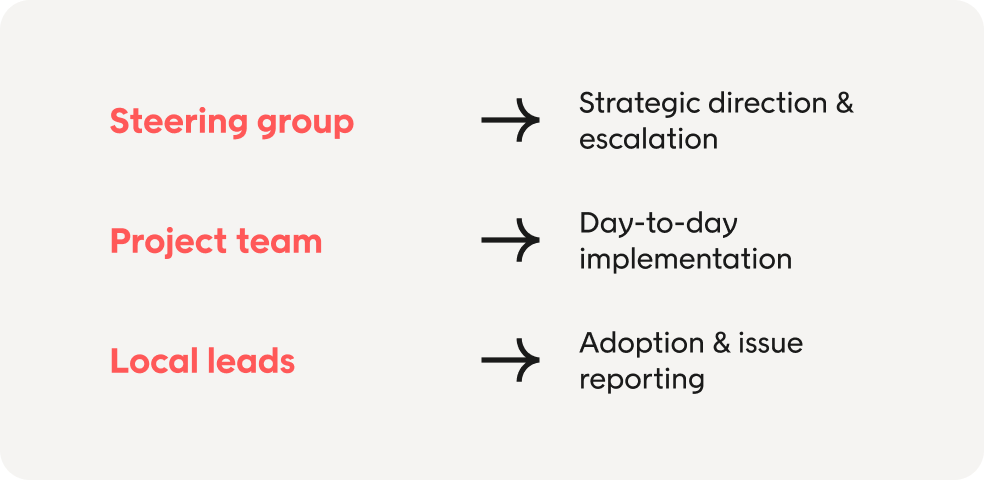
Schedule regular check-ins. Track adoption, challenges, and quick wins.
Guard against “pilot forever.” Set clear criteria to achieve scale or adjust course.
Strong governance protects momentum and keeps transformation aligned with organizational goals.
But rollout is not the finish line.
Step 5: Sustain and scale the change
This is where many transformation projects fade. Now it’s time to move from project mode to ownership.
Clarify:
- Who owns journeys long term?
- Who updates training and documentation?
- Who monitors metrics and continuous improvement?
Create a backlog for CX and operational improvements. Keep developing new skills and refining processes as your organization evolves.
Share success stories between markets and teams. Celebrate quick wins. Reinforce the benefits.
Sustaining change is not glamorous. But it’s what turns structured change management into long-term success.
And once you can run this cycle confidently, change management in retail stops feeling reactive and starts becoming a repeatable capability.
But even with a strong structure in place, you’ll still run into friction. That’s normal. What matters is knowing where problems typically show up and how to respond without losing momentum.
Common change management challenges in retail, and how to handle them
You now have the framework and steps you need to move toward change. But even with structured change management, real life happens.
Change management in retail unfolds inside a busy retail organization. Stores are under pressure. Systems are evolving. Leadership wants results fast.
These are the common challenges we see in organizational change management, and how to navigate them without losing momentum.
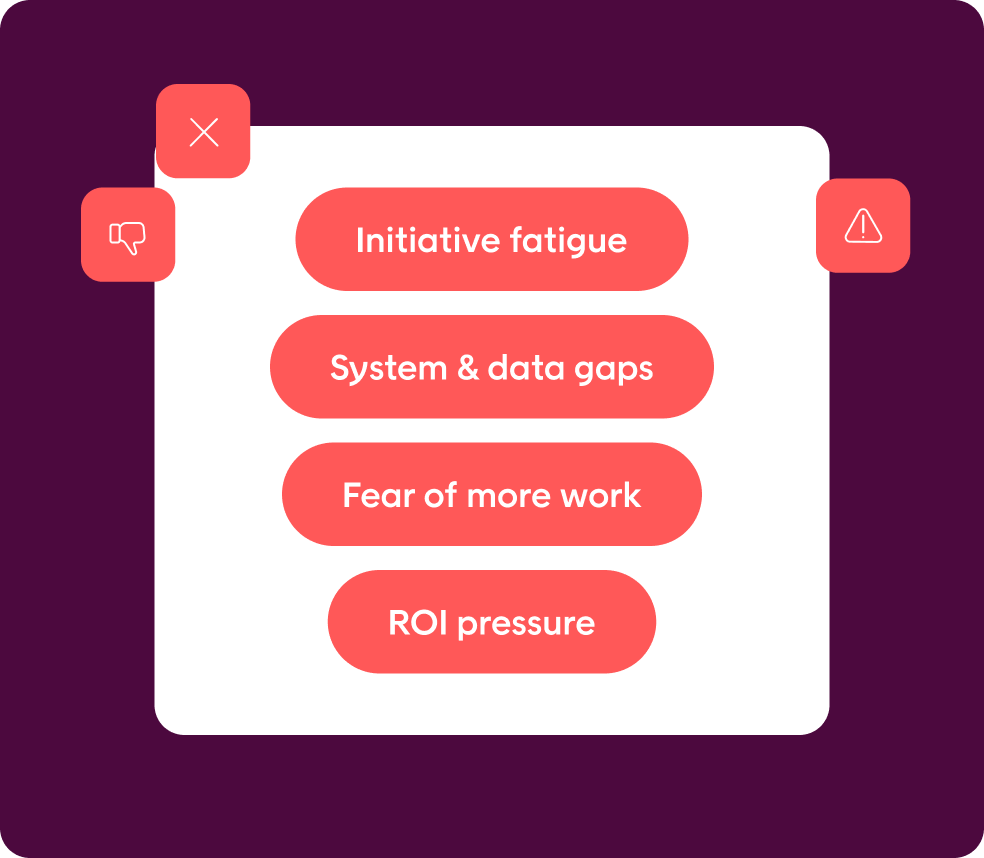
“We’ve tried this before and nothing stuck”
This is initiative fatigue.
Your teams have seen transformation projects come and go. A new system launches. Training happens. Then attention shifts.
So when you introduce new technology, skepticism shows up fast.
What’s really happening?
People don’t doubt the idea. They doubt the follow-through.
How to handle it
Start smaller than you think.
- Deliver quick wins that are visible.
- Involve frontline employees early, not after decisions are made.
- Avoid over-promising impact or aggressive timelines.
Strong change management strategies rebuild trust through proof, not promises.
When key stakeholders see measurable progress in one store or workflow, credibility grows again. And that makes broader adoption easier.
System integration and data readiness
Sometimes resistance isn’t cultural. It’s technical.
Your change depends on integrations, clean data, and stable systems. If those foundations are shaky, even the best plan feels chaotic.
This is one of the most common challenges in change management in retail.
How to handle it
Treat technical readiness as parallel work, not phase two.
- Prioritize minimum viable integrations first.
- Align business scope with IT capacity.
- Be transparent about system dependencies.
Effective organizational change management recognizes that business processes and new technology evolve together. You don’t wait for perfection, but you don’t ignore reality either.
Clarity reduces friction.
Store culture and fear of “more work”
When new CX tools arrive, store teams often assume one thing.
More admin.
Even if the goal is better customer experience, employees worry about extra steps and added pressure.
That reaction is not resistance to change. It’s the protection of their daily workflow.
How to handle it
Make simplification visible.
- Show how the new system removes manual tasks.
- Remove old processes when new ones launch. Do not double up.
- Involve store managers as key stakeholders in shaping how changes apply locally.
If you want change management strategies to work, the experience must feel lighter, not heavier.
When employees see real-time savings, adoption accelerates.
Proving ROI to leadership
Leadership wants commercial results like conversion, retention, and growth. That pressure can push you to measure too early or oversell impact.
How to handle it
Anchor KPIs in clear business outcomes:
- Conversion rates
- Repeat purchase
- Customer lifetime value
- Operational efficiency
Use pilot versus non-pilot comparisons. Combine data with qualitative stories from customers and store teams.
This strengthens support from senior leaders and other key stakeholders. It also protects your change initiative long enough to achieve long-term success.
Change rarely fails because the idea was wrong. It fails because friction was underestimated.
When you anticipate these common challenges and respond with practical change management strategies, you shift from reactive to proactive.
And that’s when organizational change management becomes a real capability inside your retail organization, not just a one-time project, which is exactly where the right retail-focused partner can make a difference.
How Voyado fits into retail change management
When your platform goes live, change becomes real. This is where many initiatives either gain momentum or lose it.
Implementing a CX or loyalty platform is not just a software setup. It’s change management in retail in practice.
When you implement a new CX or loyalty platform, you’re managing change, not just software
Introducing a platform like Voyado shifts how your organization works.
It usually means:
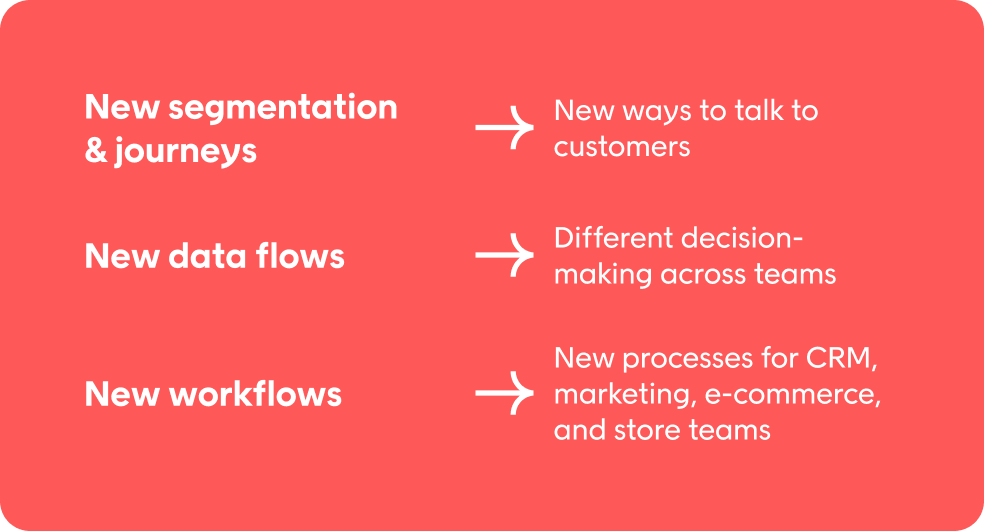
You’re redesigning behavior, not just installing a system.
That’s why effective change management is critical. Without it, adoption slows and value stalls.
Retail-focused implementation and best practices
Retail transformation follows familiar patterns. Loyalty redesign. Reactivation. Omnichannel orchestration.
A retail-focused partner brings:
- Proven journey templates
- Learnings from other retailers
- Guidance on data and integration requirements
This reduces risk and supports structured change management from day one.
Enabling agentic, data-driven ways of working
Agentic capabilities change how teams operate, leading to less manual list building and more strategy and optimization.
That shift requires trust in AI, clarity around roles, and strong stakeholder engagement.
Change management helps teams move from manual execution to oversight and creativity without friction.
Your next steps
If you’re preparing your next CX or loyalty initiative, now is the time to think beyond implementation.
When you book a demo, you’re exploring how a retail-native platform can support your change journey from rollout to measurable growth. You can also learn more about Voyado’s retail focus at Voyado.
FAQs on change management in retail
What is change management in retail?
Change management in retail is the structured way a retail organization plans, communicates, and sustains changes to systems, processes, and roles so that transformation delivers real results.
What are examples of change management in retail?
Examples include rolling out a new CX or loyalty platform, replatforming e-commerce, or shifting to data-driven workflows; platform rollouts like implementing Voyado are often the moment retailers realize they need a clear change approach, not just a technical setup.
Who should own change management in a retail company?
Executive leaders set direction, but a cross-functional team should own execution, with clear accountability across key stakeholders in stores and central functions.
How long does a retail change management project usually take?
It depends on scope, but most transformation initiatives run in phases over several months, moving from pilot to rollout to continuous improvement.
How does change management support digital and omnichannel initiatives?
It aligns systems, processes, and teams so new technology and omnichannel strategies are adopted consistently and deliver measurable business impact.