TL;DR
AI agents for retail are autonomous systems that act inside the customer journey using retail context like products, inventory, loyalty, and customer data. In 2026, retailers are moving from copilots to agentic AI because recommendations alone are not enough. AI needs to execute decisions, reduce manual work, and drive real business outcomes. This list is organized by journey stage so you can see where different retail AI agents actually fit, from acquisition to retention and operations. It is for retail leaders, e-commerce teams, and CRM and loyalty owners who want AI that delivers personalized customer experiences, supports human oversight, and works with existing systems, not disconnected AI tools.
What are AI agents in retail? (Quick definition)
AI agents in retail are autonomous AI systems that operate inside the customer journey. They use retail context like customer data, inventory, loyalty programs, and consent to make decisions and take action, not just provide suggestions.
Unlike traditional automation tools, they are built to adapt to customer behavior and support real business outcomes with human oversight.
AI agents vs. other retail AI tools
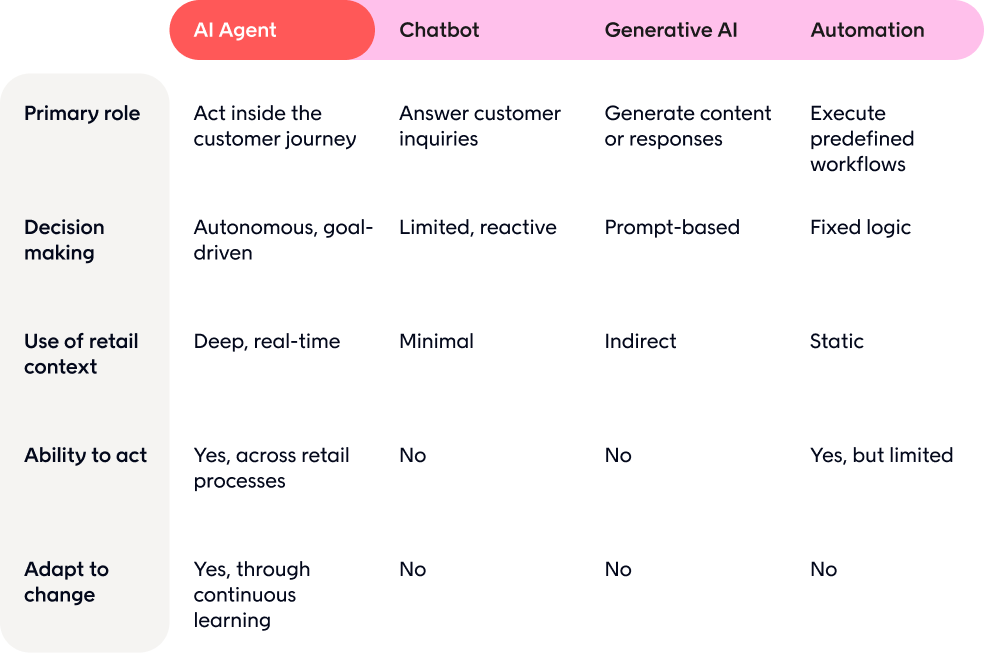
What makes an AI agent agentic
- Goal-oriented and focused on measurable business outcomes
- Context-aware across customer interactions, products, inventory, and loyalty
- Capable of autonomous decision-making with human intervention when needed
- Able to act inside existing systems, not just suggest next steps
These differences matter because not every AI tool belongs in the same place. Some support tasks. Others actively shape customer interactions and retail operations.
Next, we’ll break down the best AI agents for retail by customer journey stage, so you can see where each type creates the most value and how to deploy agents that actually move the needle.
10 best AI agents for retail (2026)
Not all AI agents solve the same problems. Some support customer service. Others optimize merchandising, loyalty, or retail operations.
This list focuses on AI agents for retail that act inside the customer journey, grouped by where they create the most impact, not by feature lists or hype.
1. Voyado agentic AI – embedded across the retail journey

Voyado is an agentic customer experience suite built specifically for retail. Its AI agents operate inside live customer journeys, using customer data, product data, inventory, and loyalty context to decide and act across channels.
Journey stage: Discovery → Retention
Best for: Retailers who want AI agents embedded into CRM, loyalty, and omnichannel activation.
Why it’s #1
Voyado’s AI agents for retail are embedded into real retail workflows, not layered on top. They enable autonomous decision-making with human oversight and execute actions that drive customer engagement, revenue growth, and long-term customer value.
Standout capabilities
- Agent-driven segmentation and journey optimization using real-time data
- Context-aware personalization across e-commerce and in-store touchpoints
- Loyalty and lifecycle automation tied to customer behavior
- Revenue-focused outcomes, not isolated AI tools
Retail caveats
Best suited for retailers focused on long-term customer value and loyalty, not one-off chat or support use cases.
2. Salesforce Agentforce (retail)
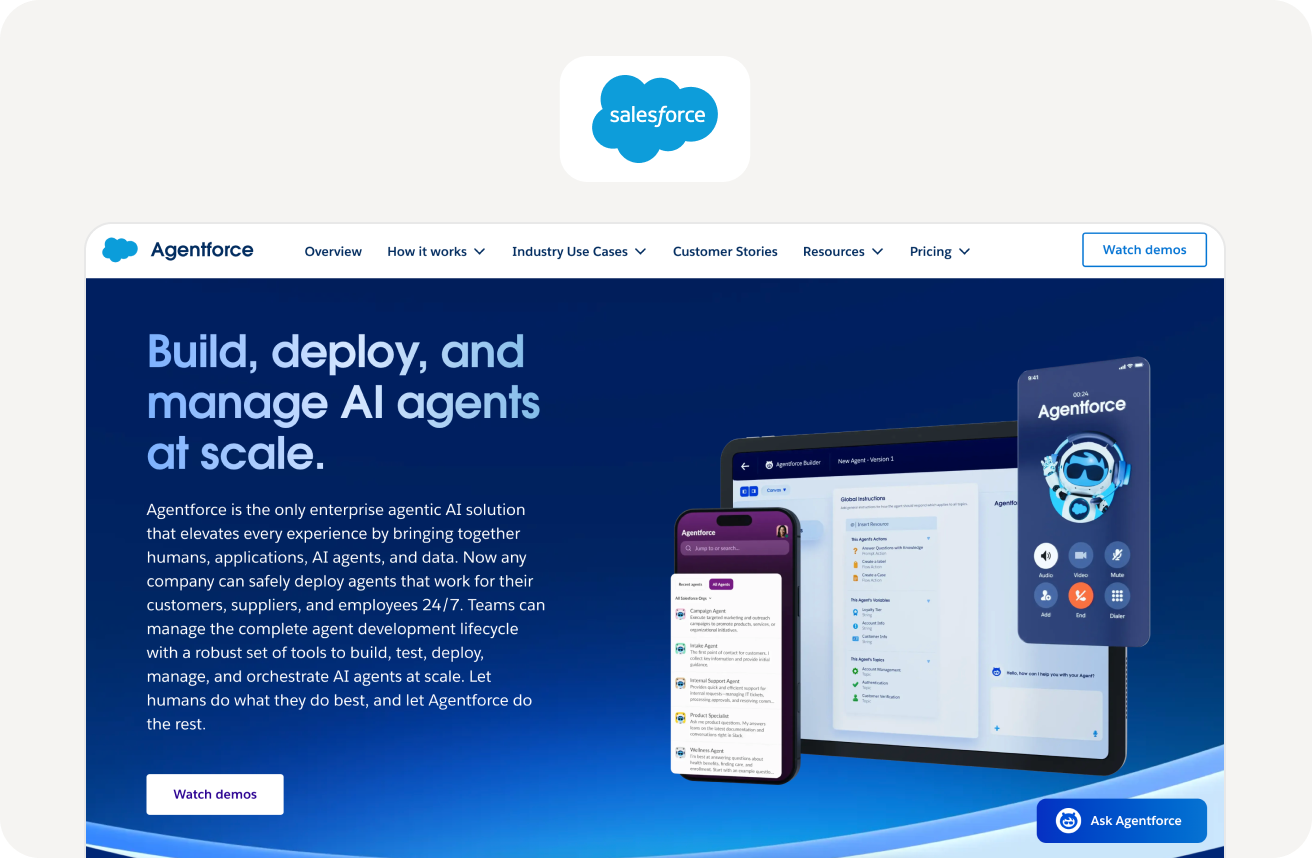
Salesforce Agentforce brings autonomous AI agents into the Salesforce ecosystem, with retail-specific use cases across service, sales, and internal operations.
Journey stage: Service, sales, operations
Best for: Enterprise retailers already running complex Salesforce stacks.
Why it stands out
Agentforce focuses on automating customer service agents, internal workflows, and decision support inside Salesforce, using customer data and existing systems.
Standout capabilities
- Autonomous handling of customer service inquiries
- Workflow execution across CRM and service clouds
- Strong human oversight and escalation controls
Retail caveats
Less focused on end-to-end customer journey activation or loyalty-driven personalization.
3. Gorgias AI agent
Gorgias offers AI agents built for e-commerce customer service, tightly integrated with Shopify and order data.
Journey stage: Customer service, conversion recovery
Best for: Shopify-first retail brands with high support volume.
Why it stands out
Gorgias uses AI agents to resolve repetitive tasks, respond to customer inquiries, and recover revenue during support interactions.
Standout capabilities
- AI-driven customer service agents
- Order-aware responses tied to customer interactions
- Fast deployment for lean teams
Retail caveats
Primarily service-focused, not designed for broader retail operations or lifecycle orchestration.
4. Ada AI
Ada provides AI agents designed to automate customer support across channels and languages at scale.
Journey stage: Support, multilingual customer experience
Best for: Global retailers with large, distributed service teams.
Why it stands out
Ada specializes in autonomous AI agents that handle high volumes of customer service inquiries while maintaining consistent customer satisfaction.
Standout capabilities
- Multilingual virtual assistants
- AI-driven intent recognition and resolution
- Integration with existing support systems
Retail caveats
Focused on support efficiency rather than retail-specific personalization or loyalty use cases.
5. Zowie
Zowie uses AI agents to automate post-purchase and support interactions, with a strong emphasis on cost reduction.
Journey stage: Post-purchase, service automation
Best for: Retailers prioritizing deflection and operational efficiency.
Why it stands out
Zowie’s AI agents handle repetitive customer interactions and automate responses using real-time data from order and delivery systems.
Standout capabilities
- Autonomous resolution of common support questions
- Fast deflection of repetitive tasks
- Clear ROI focus on support costs
Retail caveats
Limited reach beyond customer service and post-purchase workflows.
6. parcelLab AI agents
parcelLab uses AI agents for retail to manage post-purchase communication, delivery updates, and returns, turning service moments into loyalty drivers.
This focus on post-purchase moments reflects a broader shift toward AI-driven retail experiences, where agents act on real-time data to reduce customer inquiries and improve customer satisfaction.
Journey stage: Post-purchase, returns, loyalty
Best for: Retailers focused on WISMO reduction and post-purchase customer engagement.
Why it stands out
parcelLab applies AI agents in retail to automate customer interactions after checkout, using real-time data from logistics partners and existing systems.
Standout capabilities
- AI-driven post-purchase messaging and return flows
- Customer service agents supported by automation, not replaced
- Strong impact on customer satisfaction and loyalty programs
Retail caveats
Limited to post-purchase use cases, not broader retail operations or merchandising.
7. Triple Whale Moby agents
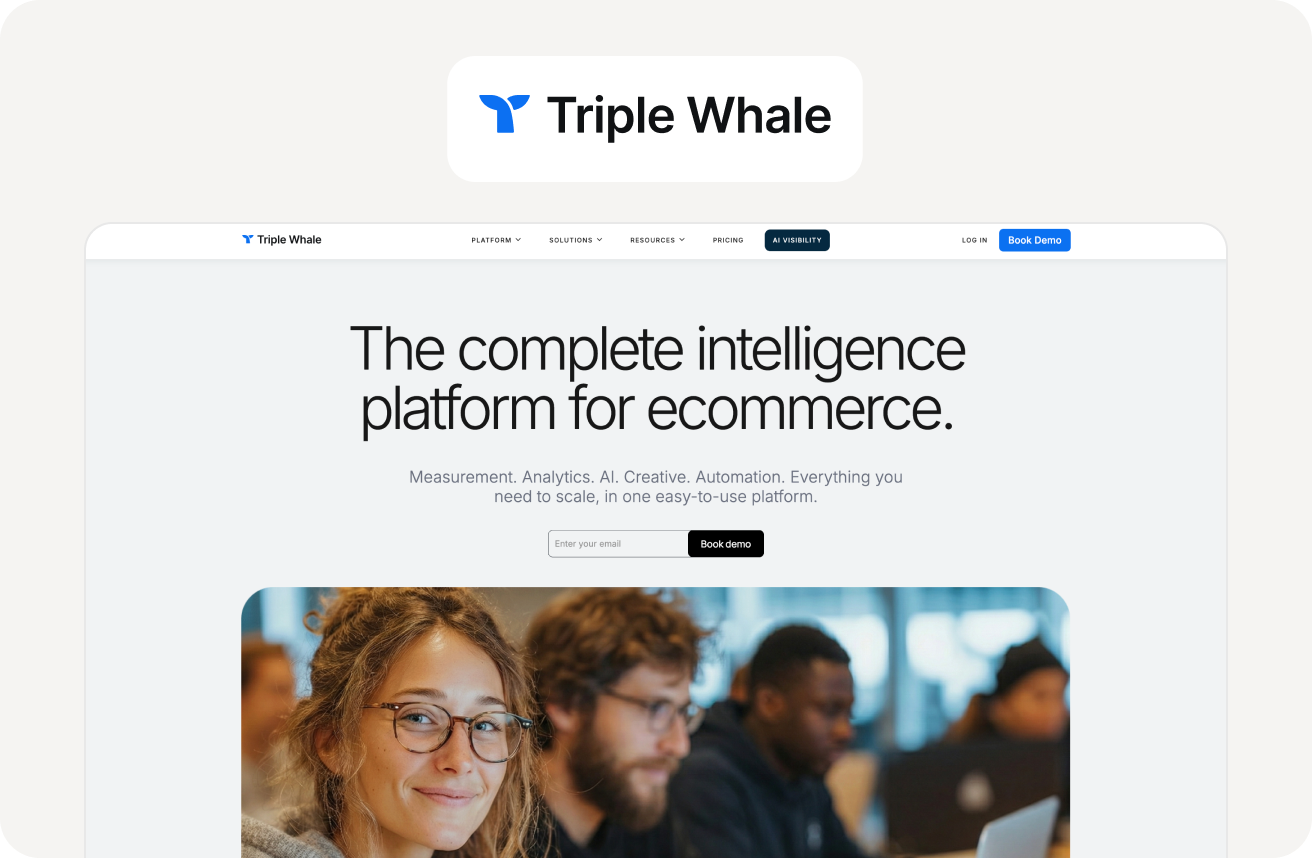
Triple Whale offers intelligent agents that support data analysis and decision-making for performance-driven retail teams.
These analytics-focused agents highlight why personalization and insight must connect to action, a theme explored further in personalization in retail as retailers move beyond dashboards toward agentic AI systems.
Journey stage: Analytics, decision intelligence
Best for: E-commerce teams optimizing growth and spend efficiency.
Why it stands out
Moby applies generative AI and predictive analytics to help teams understand customer behavior, market trends, and business outcomes.
Standout capabilities
- AI agents offer insight-driven recommendations
- Strong focus on decision-making and revenue growth
- Designed for fast agent adoption by lean teams
Retail caveats
Advisory-focused agents that support decisions but do not execute actions inside customer journeys.
8. Microsoft Copilot (retail scenarios)
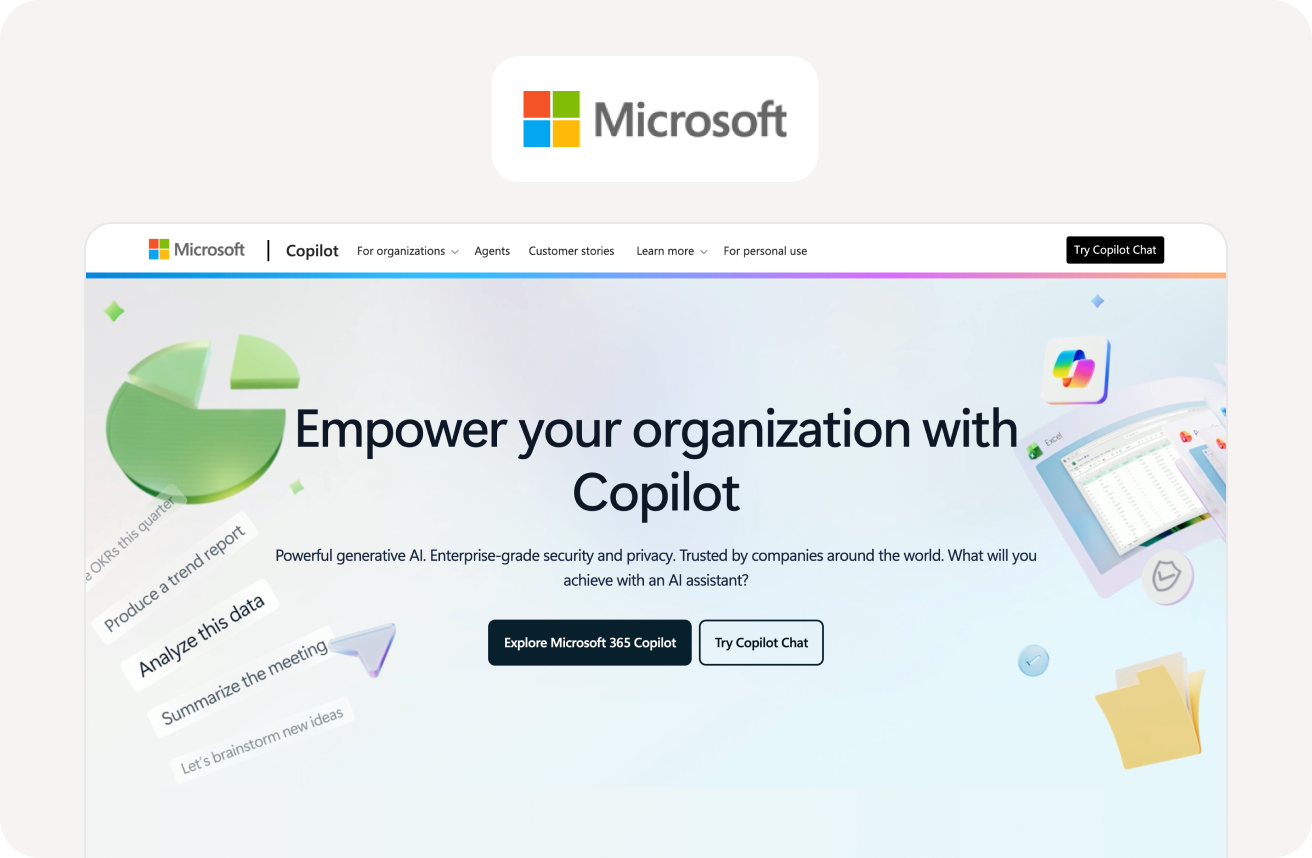
Microsoft Copilot applies artificial intelligence across internal retail processes, using enterprise data and AI models embedded in Microsoft tools.
Journey stage: Internal operations, planning, merchandising
Best for: Retail companies standardized on Microsoft ecosystems.
Why it stands out
Copilot supports human teams with intelligent systems that automate manual tasks and improve operational efficiency across business operations.
Standout capabilities
- Virtual assistants for planning and reporting
- Integration with existing data and tools
- Strong human oversight and human input controls
Retail caveats
General-purpose AI tools, not retail-native agents embedded into customer experience execution.
9. SymphonyAI retail agents
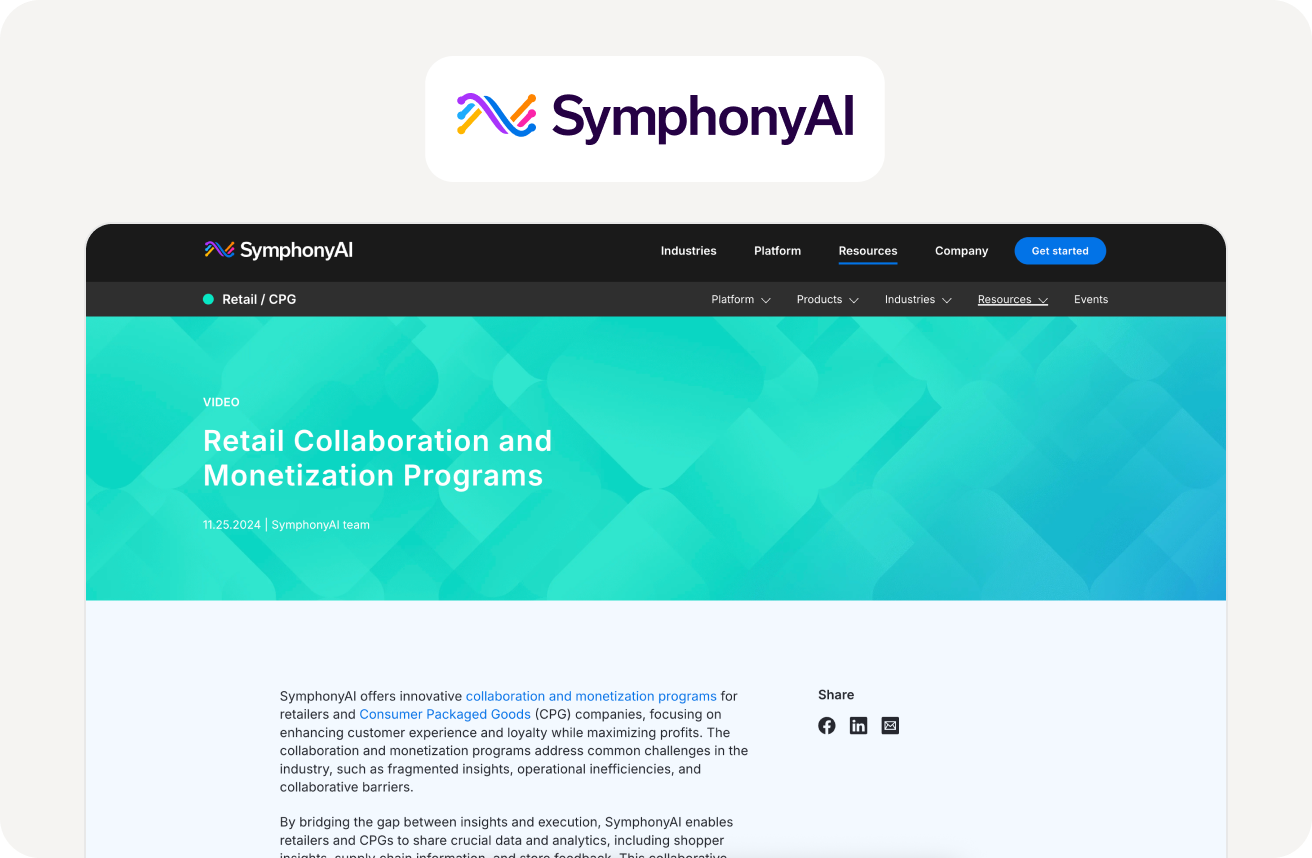
SymphonyAI provides enterprise-grade AI agents focused on retail operations, merchandising, and supply chain management.
Journey stage: Operations, supply chain, merchandising
Best for: Large retailers optimizing inventory management and supply chains.
Why it stands out
SymphonyAI deploys autonomous systems that analyze large volumes of training data to improve demand forecasting and optimizing operations.
Standout capabilities
- Retail AI agents for inventory and supply chains
- Advanced decision making across retail processes
- Designed for complex, high-scale environments
Retail caveats
More operational than experiential, with limited impact on personalized customer experiences.
10. Capacity AI agents
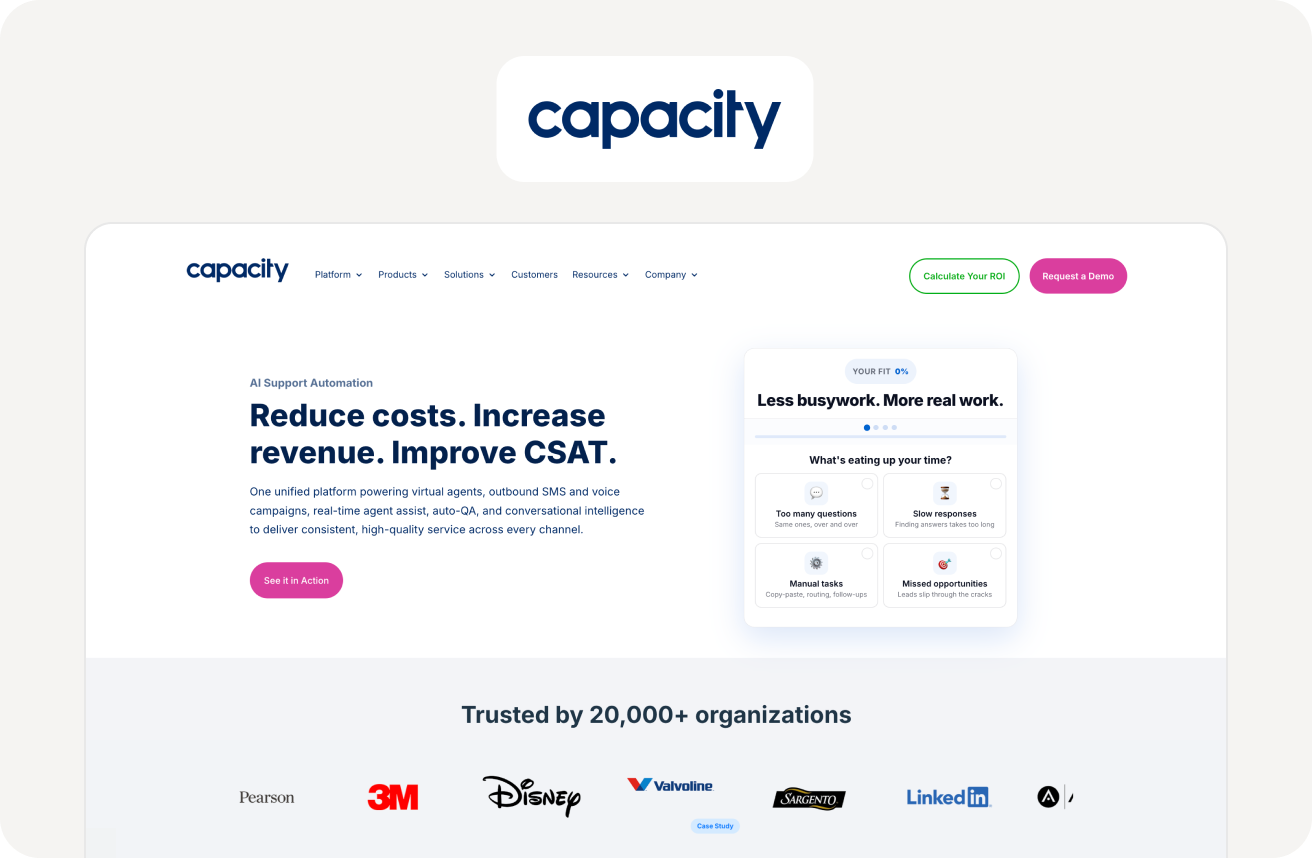
Capacity offers AI agents for retail support and internal workflows, focusing on speed and consistency across teams.
Journey stage: Support, internal workflows
Best for: Retailers automating repetitive tasks across departments.
Why it stands out
Capacity uses intelligent agents to resolve customer service inquiries and internal requests, reducing reliance on human agents for routine work.
Standout capabilities
- Automation tools for customer service inquiries
- Clear boundaries for human intervention and human oversight
- Fast deploy agents model for internal teams
Retail caveats
Process-focused agents that support efficiency, not end-to-end customer journey orchestration.
Tying it all together:
Across these examples, the difference is clear. Some AI agents support narrow tasks like customer service or analytics. Others operate across the customer journey and retail operations.
The strongest AI agents for retail are embedded into existing systems, act on real time data, and balance autonomous decision-making with human oversight.
That distinction shaped how this list was curated.
How we evaluated these AI agents
We evaluated these AI agents for retail based on whether they can act inside real retail journeys, not just analyze data or answer prompts.
This approach reflects Voyado’s research on agentic AI in the retail industry, which shows that value comes from agents that combine retail context with execution, not isolated AI tools.
Evaluation criteria
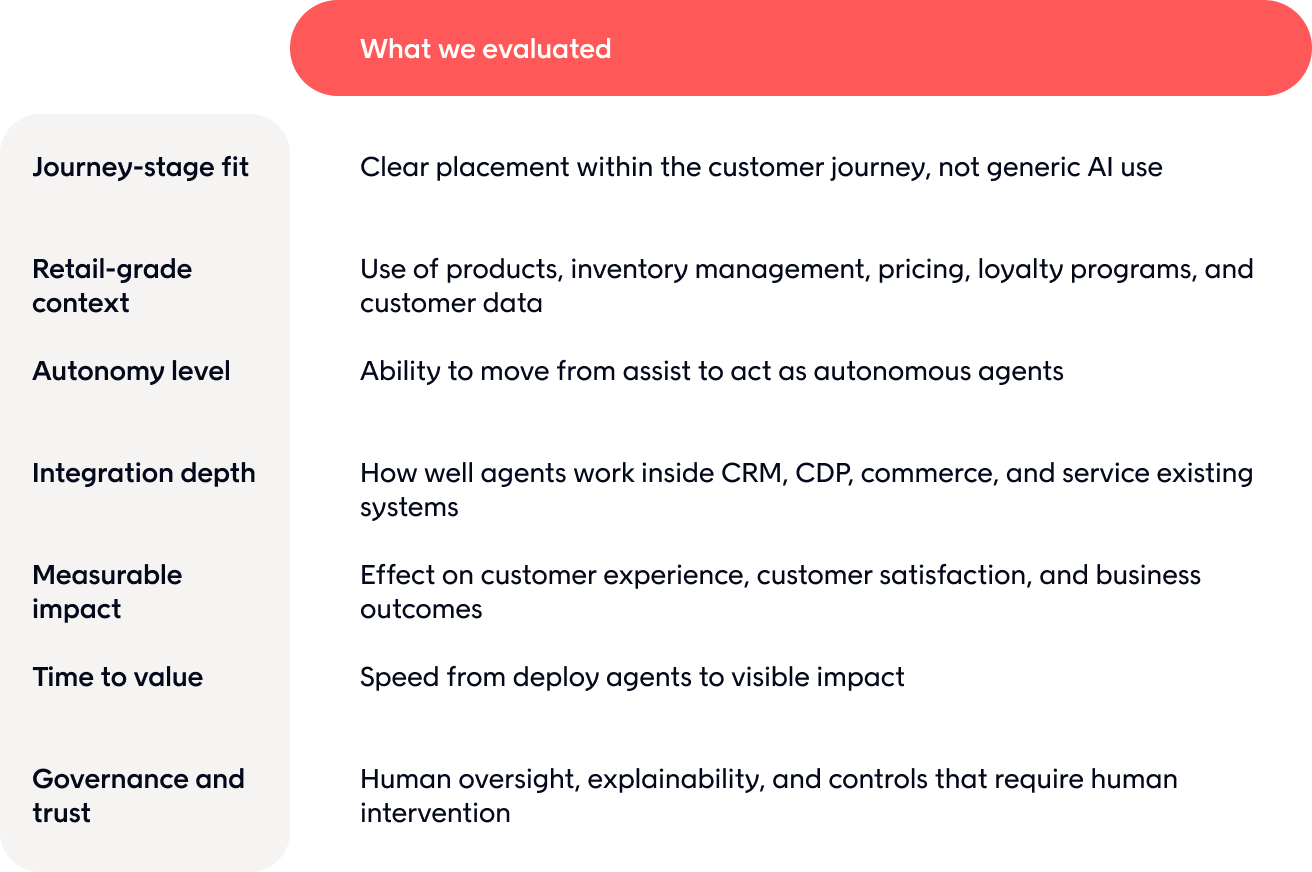
Why this matters
Unlike traditional automation tools, effective retail AI agents must operate inside live retail processes. That means acting on real-time data, understanding customer behavior, and supporting customer interactions without removing human teams from the loop.
Agents that lack retail context or governance may increase activity, but they rarely deliver exceptional customer experiences or long-term competitive advantage.
This framework reflects how retail companies and business leaders approach AI adoption today.
The focus is shifting toward enterprise-grade AI agents that support decision-making across retail operations, supply chain management, and loyalty, while maintaining trust, control, and operational efficiency.
Next, we’ll look at how Voyado applies these principles in practice, and why retail-native, agentic AI systems stand out when embedded across the full customer journey.
How Voyado helps retailers deploy AI agents that actually perform
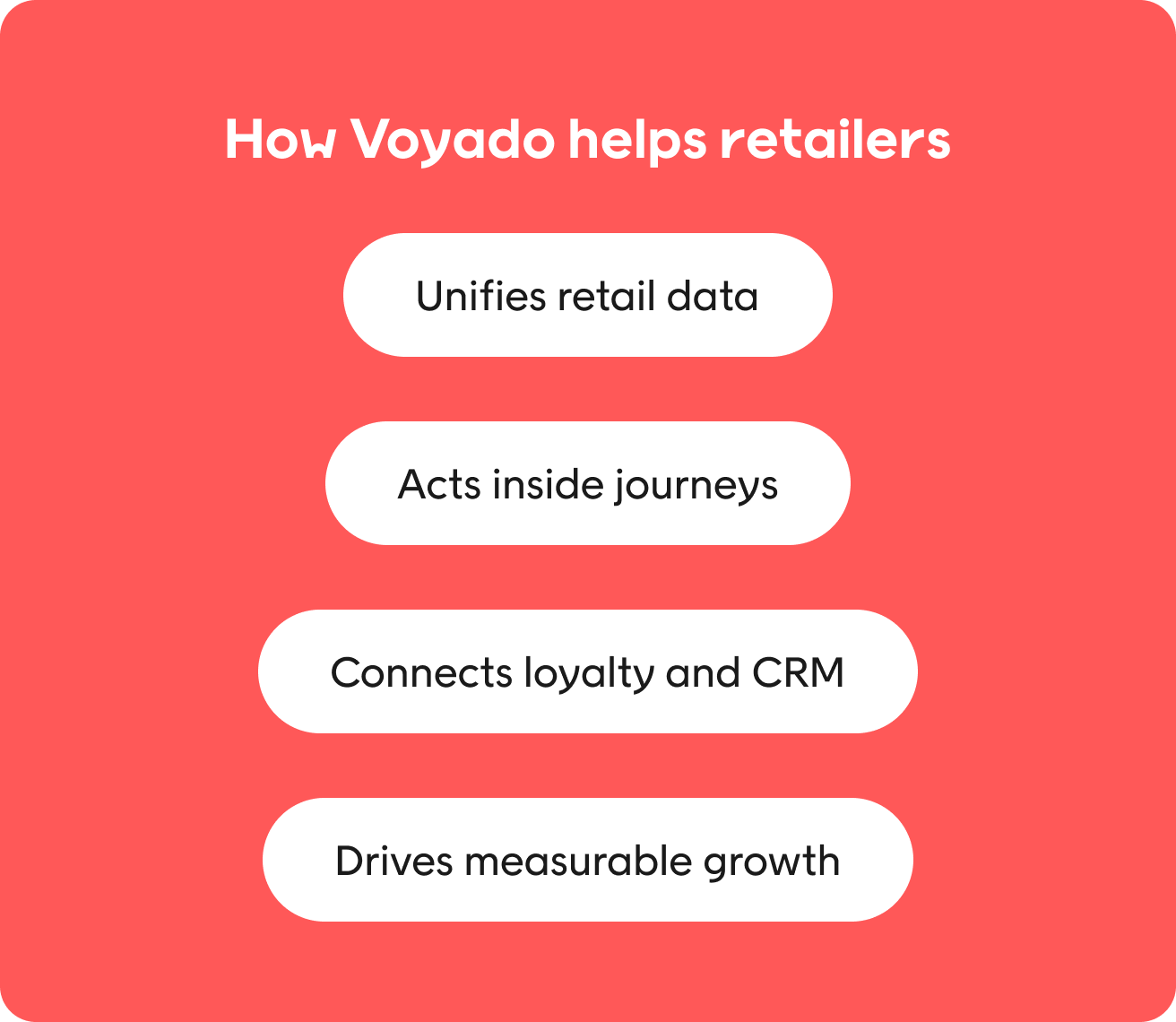
Retail AI only delivers value when it is embedded into real journeys and real retail processes. We’ll show how Voyado enables AI agents for retail to act inside the customer journey, using retail-native context and built-in execution, not standalone AI tools.
Built on a retail-native data foundation
Voyado is built specifically for the retail industry. It brings together customer data, inventory management, loyalty programs, and consent into one system, giving AI agents the context they need to operate inside live customer journeys.
This foundation allows agents to act on what is happening now, not on fragmented or delayed data from disconnected systems.
Voyado’s perspective on getting ahead with AI in retail reinforces why retail-native context is now table stakes.
Agentic decision making inside live journeys
Voyado’s agentic AI does not sit inside dashboards. It operates directly inside customer journeys.
That means AI agents can:
- Respond to customer behavior using real-time data
- Adjust interactions as journeys unfold across channels
- Support decision-making where customer interactions actually happen
To keep trust and control intact, Voyado balances autonomy with clear guardrails:
- Human oversight is built into how agents act
- Human intervention is possible when decisions need review
- Human teams stay in control of strategy and outcomes
The result is fewer manual tasks for teams and more consistent customer interactions at scale, without replacing people or removing accountability.
Loyalty, CRM, and engagement in one system
Because CRM, loyalty, and customer engagement live together, retail AI agents can act consistently across discovery, conversion, and retention. This reduces friction across retail processes and helps teams deliver more relevant, personalized customer experiences.
Voyado’s approach aligns closely with how personalization in retail works best when data, activation, and loyalty programs are connected, rather than managed in separate tools.
Designed for measurable growth, not demos
Voyado’s AI agents offer measurable business outcomes. They are built to improve operational efficiency, strengthen loyalty programs, and drive revenue growth across retail operations, not to showcase standalone AI tools.
This makes Voyado a practical choice for retailers focused on long-term value, not short-term experimentation.
If you want to see how agentic AI works when it is embedded into real retail journeys, you can book a demo with Voyado to explore how its AI agents support loyalty, customer engagement, and measurable growth across the customer journey.
Final take
In 2026, the winners won’t be retailers with the most AI, but those that deploy the right AI agents for retail at the right moments of the customer journey.
Retailers that embed agentic AI into real journeys, supported by retail-native data and human oversight, will be better equipped to meet customer expectations, improve customer experience, and drive sustainable business outcomes across the retail industry.
FAQs
What is an AI agent in retail?
An AI agent in retail is an autonomous system that can make decisions and take action inside the customer journey. These AI agents retail solutions use retail context like customer data, products, inventory, and loyalty rules to act in real time, not just analyze or suggest.
How are AI agents different from chatbots?
Chatbots answer customer questions. AI agents in retail go further by making decisions and triggering actions across journeys and retail processes. This is what separates chat tools from autonomous AI agents that retail teams rely on for execution.
Are AI agents safe for customer-facing use?
Yes, when they are designed as enterprise-grade AI agents. The best AI agents for retail solutions include human oversight, clear guardrails, and escalation paths, making them suitable for customer-facing use across retail and e-commerce environments.
How long does it take to implement retail AI agents?
Implementation depends on how deeply AI agents for retail and e-commerce are integrated into CRM, loyalty, and commerce systems. Retailers using embedded platforms typically see faster time to value than those deploying standalone AI tools.
Can mid-market retailers use AI agents effectively?
Yes. AI agents retail teams use are not limited to large enterprises. Mid-market retailers can deploy AI agents in the retail industry to improve customer engagement, reduce manual work, and scale operations without adding complexity.
About Author