TL;DR
Agentic AI in retail goes beyond generative AI by making decisions and taking action, not just producing outputs. It matters now because signals from the National Retail Federation (NRF) and Google point to a new baseline for digital commerce, where speed, relevance, and execution drive growth, as highlighted in Voyado’s analysis of NRF 2026 trends. The biggest early impact shows up in product discovery, personalization, and loyalty, where AI can adapt across the customer journey in real time. Retailers should approach adoption as a capability shift, grounding agentic AI in strong data, clear rules, and human oversight, then activating it through platforms like Voyado that are built for action, not experiments.
What is agentic AI in retail?
Agentic AI in retail is a type of artificial intelligence that can decide and act, not just analyze data or generate content.
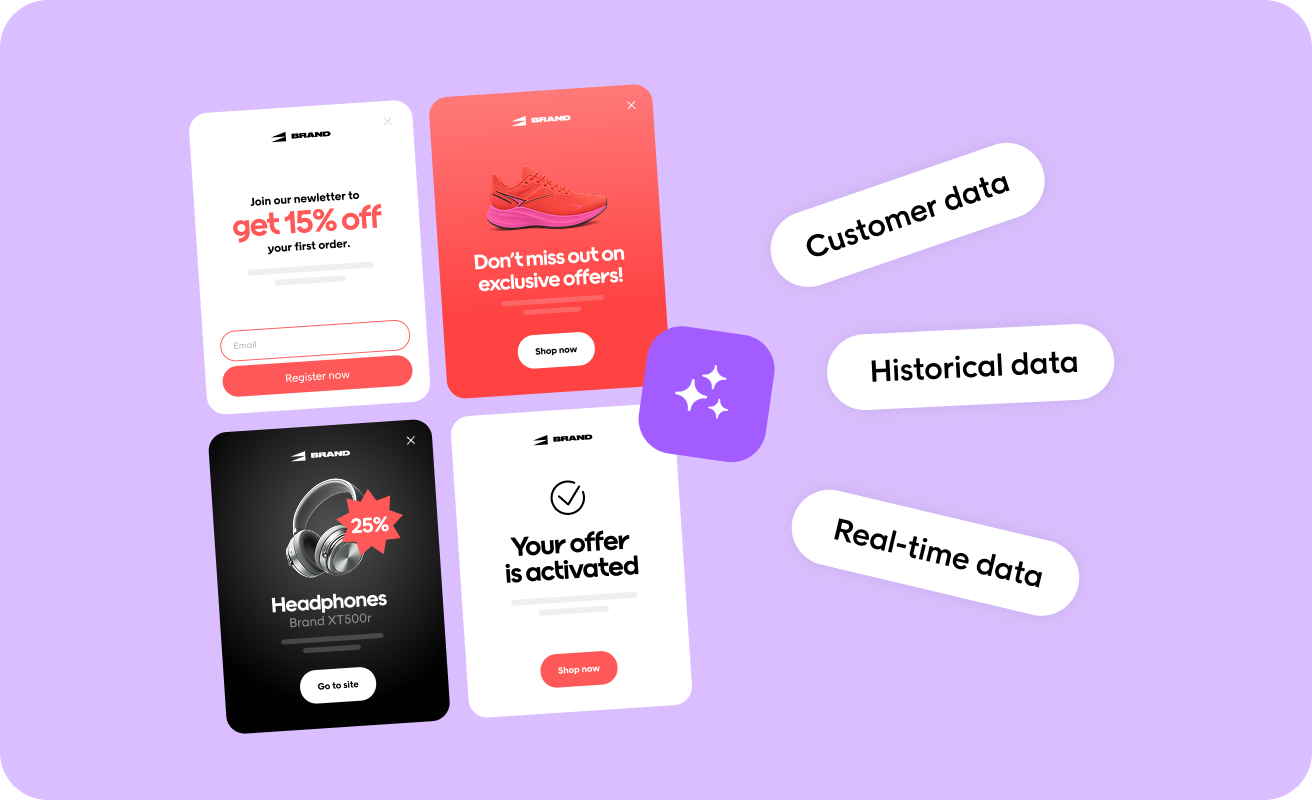
It uses customer, historical, and real-time data to choose the next best action with minimal human input, while maintaining human oversight so teams retain control.
These are the foundations of agentic AI for retail.
You are building systems that understand context, pick a goal, and execute across customer interactions.
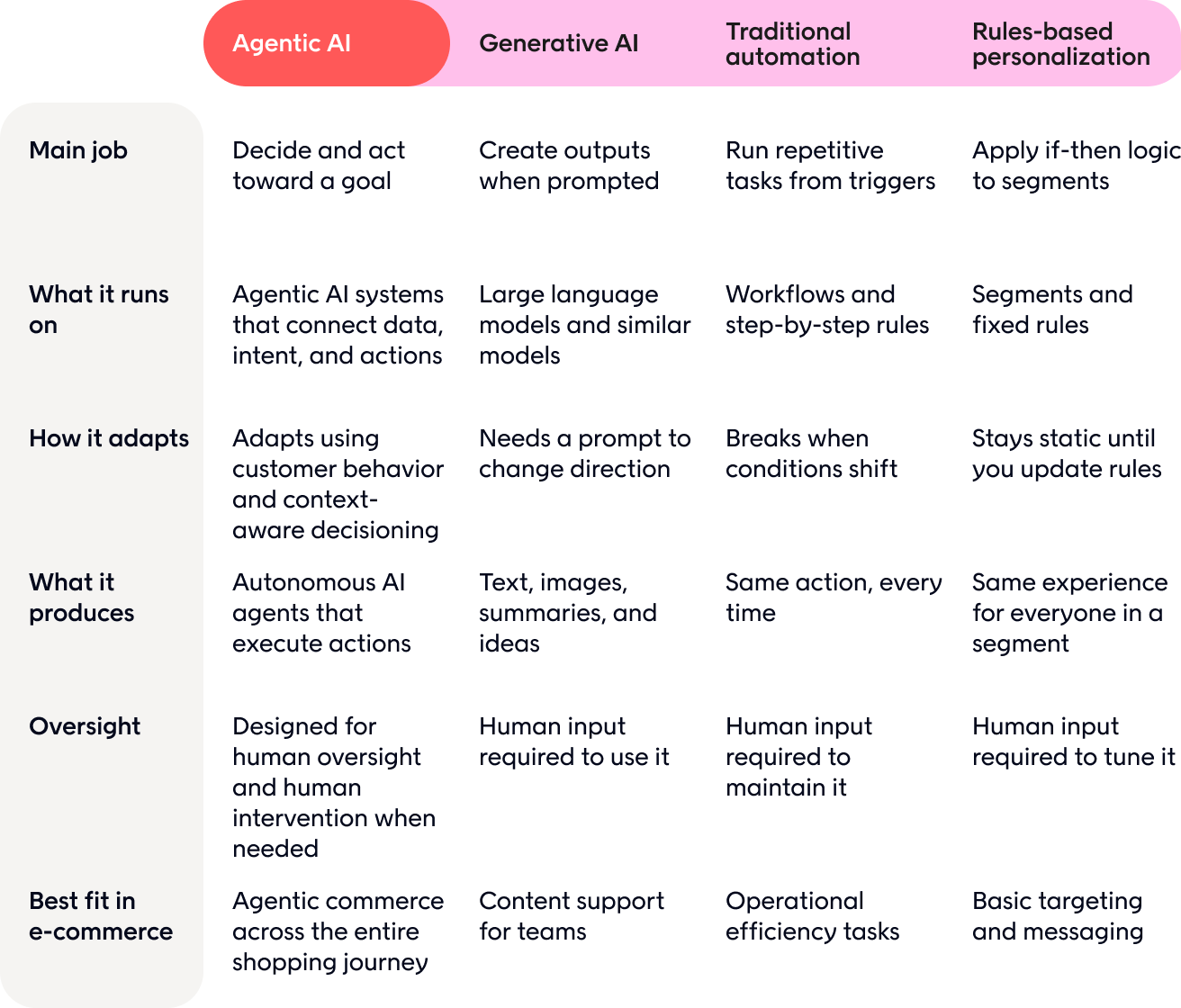
Agentic AI vs. other AI approaches in retail
Core characteristics of agentic AI
Autonomy: AI agents can act through connected autonomous systems, not just recommend.
Goal-driven behavior: Agentic AI works toward outcomes like conversion, margin, and customer loyalty.
Context awareness: Shopping agents use customer intent, along with contextual factors such as stock, price, and timing.
Continuous learning: The system learns from customer feedback and real results, not guesses.
If you want a practical benchmark, good “agent-ready” setups start with the basics in personalization in retail, then scale to agentic systems that can act on-site and in-store.
In the retail industry, the difference is simple: generative AI talks, agentic AI does. That is why leading retailers are treating AI platforms as execution layers, not just insight tools.
Now that the definition is clear, the next step is mapping where retail agentic AI creates value first. We’ll walk through agentic AI retail use cases across the customer journey, starting with product discovery.
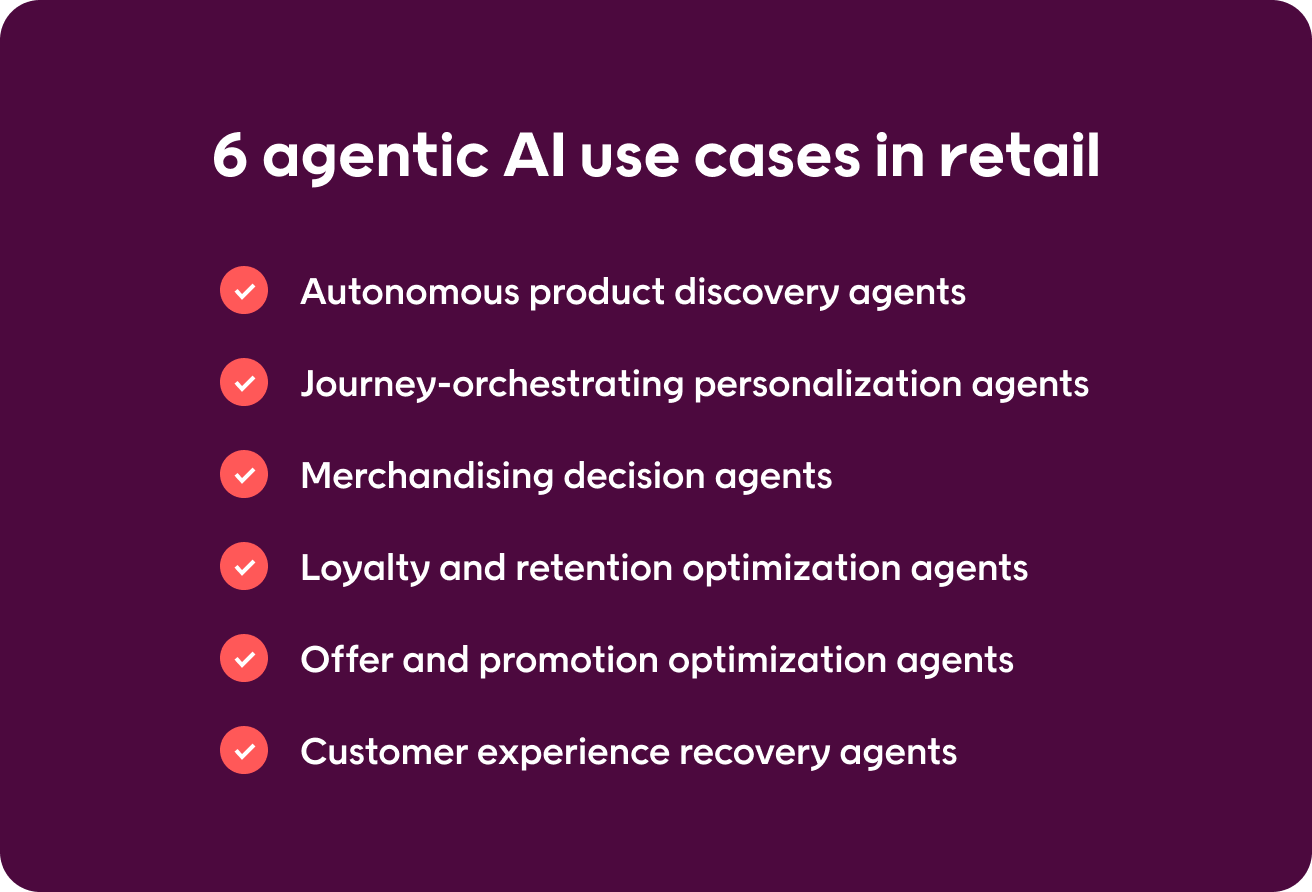
6 agentic AI use cases in retail that drive growth
This is where agentic AI in retail moves from theory to impact.
These agentic AI retail use cases show how AI agents act across the customer journey to improve discovery, engagement, and revenue, without adding manual work.
1. Autonomous product discovery agents
Autonomous AI agents power behavioral and intent-driven search, recommendations, and ranking.
Instead of relying on static rules, these shopping agents analyze customer and shopper behavior, along with historical data, to decide which products to surface in real time.
The AI agent makes ranking decisions based on context, not guesswork, across on-site and in-store experiences.
Impact
- Higher PDP engagement
- Faster path to direct purchases
- Stronger influence on consumer purchasing decisions
2. Journey-orchestrating personalization agents
These AI agents decide when, where, and how to engage customers across digital commerce touchpoints.
They coordinate customer interactions across email, SMS, and on-site moments using real-time customer intent and customer data.
This is where agentic commerce replaces channel-first thinking with journey-first execution, supported by omnichannel capabilities like Voyado’s omnichannel customer experience platform.
Impact
- Better customer engagement
- Relevance without over-messaging
- Improved customer experience across the sales funnel
3. Merchandising decision agents
Merchandising agents monitor demand signals, supply chain disruptions, and shifts in consumer behavior.
They adjust exposure, prioritization, and recommendations automatically, working alongside existing systems rather than replacing them.
These agentic systems reduce reliance on static campaigns and repetitive tasks while maintaining control through human oversight.
Impact
- Better sell-through
- Faster response to market changes
- More resilient store operations
4. Loyalty and retention optimization agents
Loyalty-focused AI agents predict churn risk and brand loyalty uplift using first-party data and customer feedback.
They trigger personalized incentives or experiences automatically, aligned with customer loyalty goals and service quality expectations.
This approach fits naturally with platforms like Voyado’s customer loyalty platform, where AI-driven decisions improve long-term value.
Impact
- Higher customer lifetime value
- Smarter loyalty economics
- Stronger customer engagement
5. Offer and promotion optimization agents
These autonomous agents continuously test offers, promotions, and dynamic pricing strategies.
They analyze data across AI systems and AI platforms to optimize incrementality, not just clicks.
By acting in AI mode with minimal human input, they help retail businesses protect margins while growing revenue.
Impact
- Revenue growth without margin erosion
- Clearer insight into what actually works
- A significant competitive edge in the retail industry
6. Customer experience recovery agents
Customer experience recovery agents detect friction, drop-off, or failed customer interactions in real time.
They trigger recovery actions automatically, such as assistance from an AI assistant, personalized follow-ups, or post-purchase support.
These agents work across the entire shopping journey, including on-site and in-store moments.
Impact
- Reduced abandonment
- Higher satisfaction and service quality
- Stronger trust with global retailers and industry leaders
Together, these examples of agentic AI in retail show how autonomous agents move beyond traditional AI. They connect customer intent, data, and execution to drive measurable growth.
The next step is understanding what makes this possible. Let’s look at the foundations retailers need in place to start implementing agentic AI, without risking control or complexity.
Foundations required for agentic AI in retail
Many platforms showcase agentic AI use cases in retail but skip what makes them viable. Without the right foundations, agentic AI in the retail industry stays fragmented and hard to scale.
These are the core capabilities that turn agentic retail into a durable growth model.
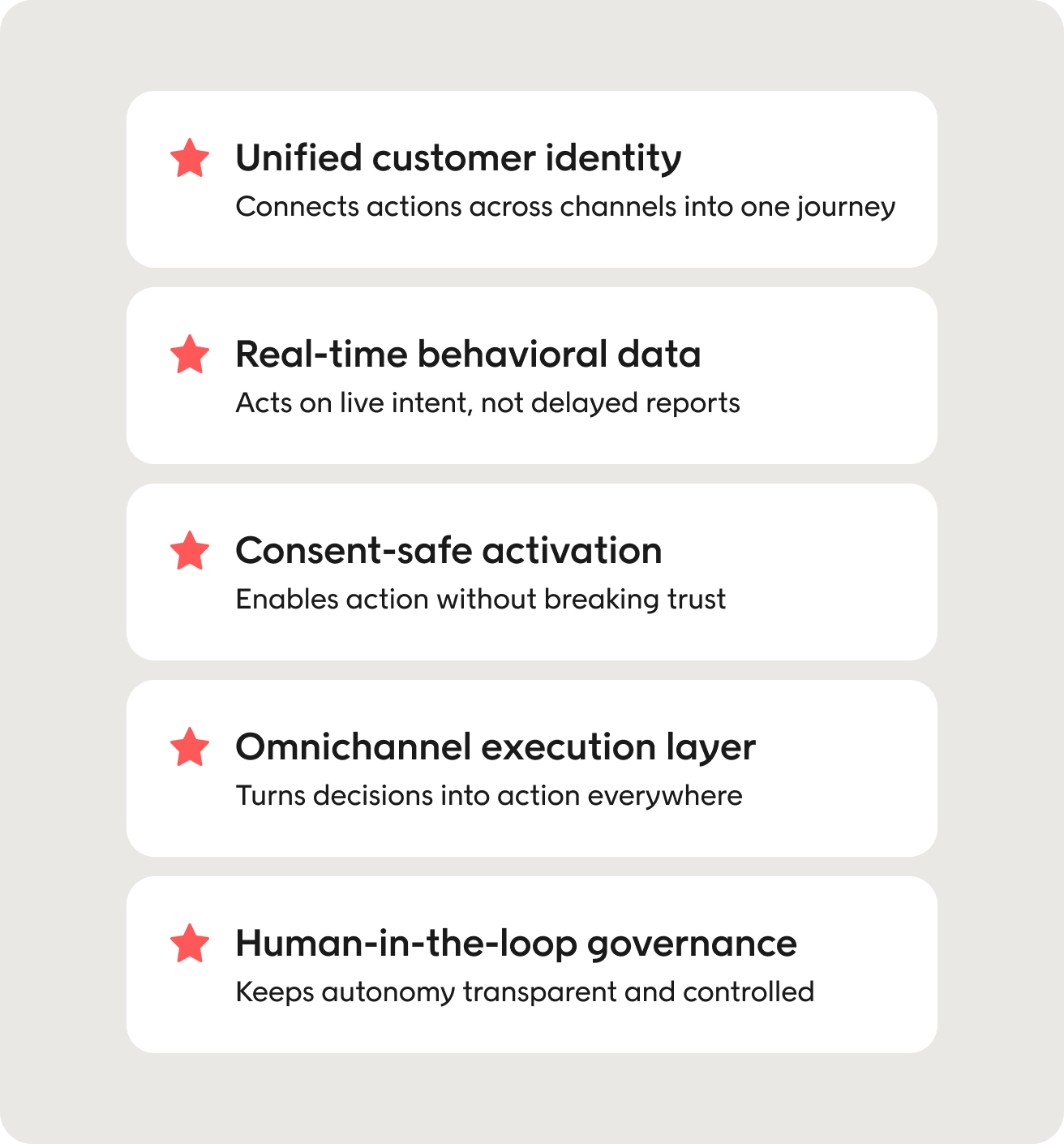
Unified customer identity
Unified identity is what allows retail agentic AI to recognize the same customer across moments, channels, and devices.
It connects actions into a single customer journey instead of isolated interactions. Without it, agentic AI retail use cases optimize in silos.
That leads to inconsistent experiences and missed opportunities, even when the AI logic itself is sound.
Real-time behavioral data
Agentic AI for retail depends on live signals, not delayed reporting. It needs to understand customer intent as it forms, not after the moment has passed.
This is what separates examples of agentic AI in retail that react instantly from those that feel slow or irrelevant.
Consent-safe activation
Agentic AI in retail must be able to act without breaking trust. Consent-safe activation ensures autonomy does not override permissions, preferences, or expectations.
When this layer is missing, agentic AI use cases in the retail industry become artificially limited or legally risky.
Omnichannel execution layer
This is where most fall short.
Agentic AI retail use cases only deliver value if decisions can be executed across every relevant touchpoint.
In practice, that means:
- Acting on-site and in-store, not just in one channel
- Coordinating timing and messaging across systems
- Avoiding handoffs between disconnected tools
This execution layer is what turns insight into impact, as outlined in Voyado’s guide to omnichannel e-commerce strategy.
Human-in-the-loop governance
Agentic retail systems are autonomous, but they are not uncontrolled. Human-in-the-loop governance defines where teams can review, intervene, and set boundaries.
This is what allows agentic AI in retail to scale safely and consistently, rather than becoming opaque automation.
These foundations of agentic AI for retail determine whether AI becomes a strategic asset or a collection of disconnected features. When these foundations are weak or missing, retailers tend to run into the same predictable problems.
Common pitfalls when adopting agentic AI
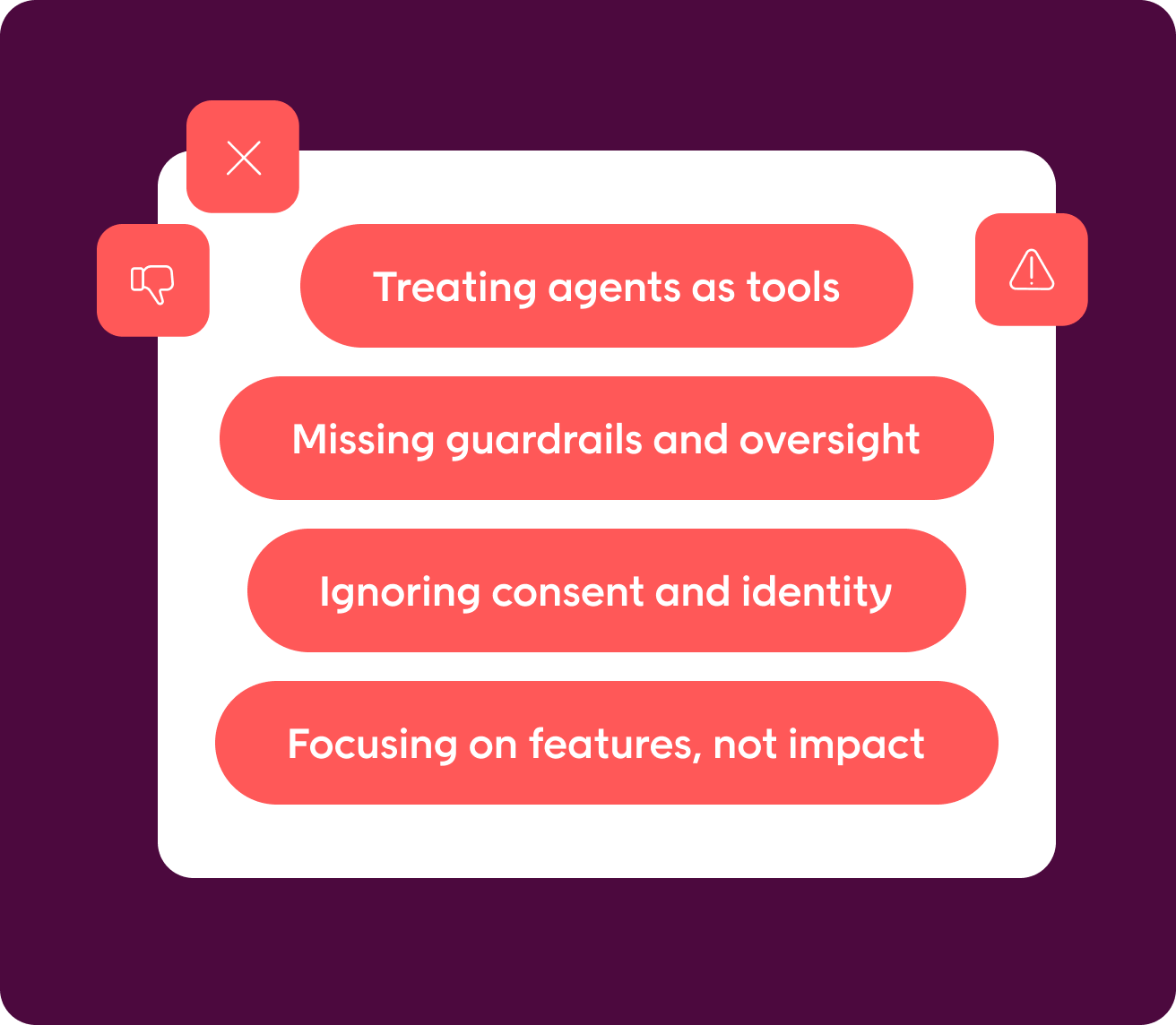
Retailers often run into the same issues when these foundations are missing or unclear.
- Treating agents as point tools instead of part of an operating model
- Letting AI act without clear business constraints or human oversight
- Ignoring retail-specific identity and consent challenges
- Focusing on AI features instead of measurable business outcomes
With these foundations in place, the focus shifts to execution. The final question is how Voyado enables agentic AI in retail to act across data, identity, and channels without adding complexity.
How Voyado enables agentic AI (without the hype)
If you’re evaluating agentic AI in retail, you’re likely not looking for another AI feature.
You’re trying to solve a bigger problem: how to move faster, stay relevant, and still keep control as decisions become more automated.
That’s where Voyado fits.
Not as an agent that replaces your teams, but as the system that makes agentic AI practical for your business.
Agent-ready, not agent-only
Voyado is built for retailers who want to use AI agents without locking themselves into one model, one vendor, or one way of working.
It gives your teams the flexibility to experiment, adopt, and scale agentic AI as your needs evolve.
For you, that means:
- Less re-platforming
- Fewer dead-end experiments
- More confidence that what you build today will still work tomorrow
What this enables for your teams
Instead of listing features, here’s what changes in practice.
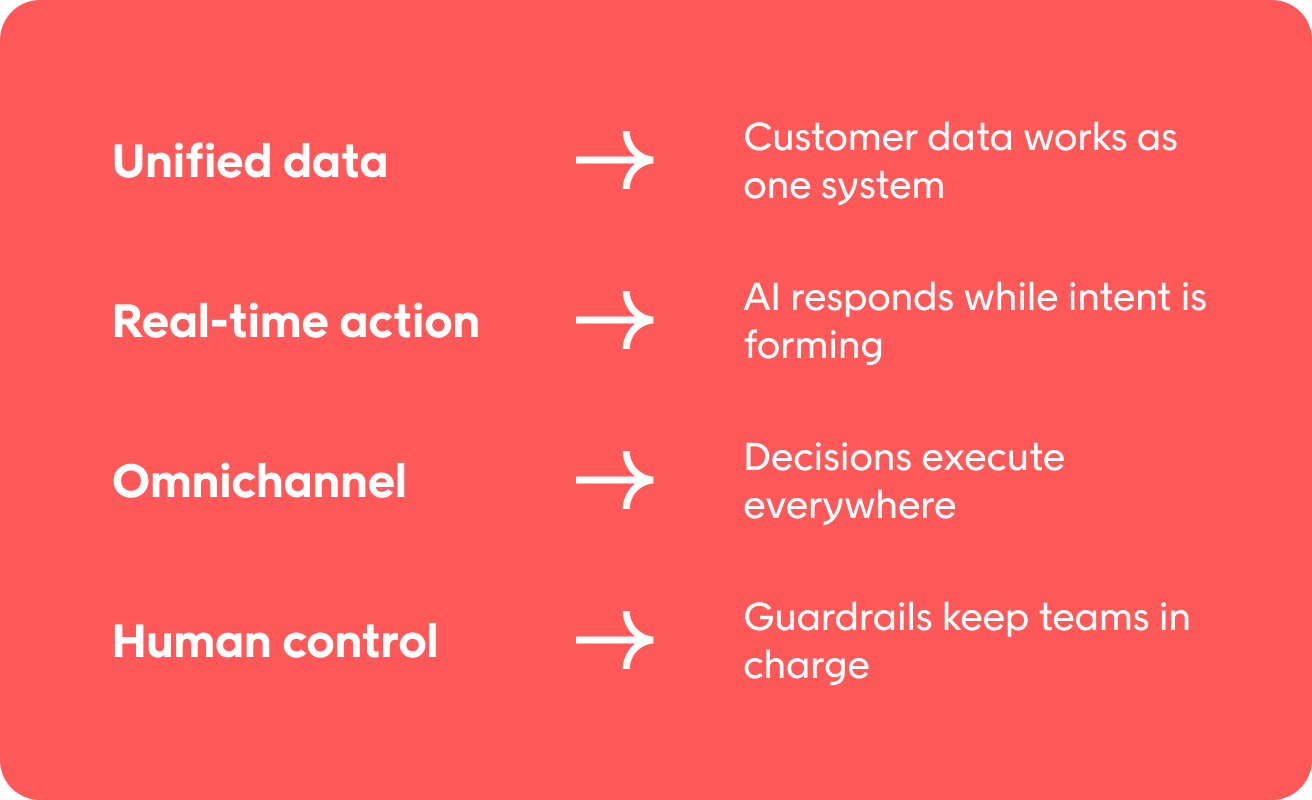
Your customer data actually works together
When customer data is unified, agentic AI can understand intent across the full customer journey. Your teams stop stitching insights together manually, and AI-driven decisions become consistent rather than conflicting.
Decisions happen in the moment, not after the fact
With real-time context, AI can respond while a customer browses, searches, or engages. That leads to more relevant experiences and fewer missed opportunities.
Actions carry through across channels
Decisions don’t stop at recommendations. They’re activated across on-site, messaging, and in-store touchpoints, so your teams aren’t stuck translating insights into execution.
You stay in control
Clear guardrails and oversight mean AI supports your strategy, not the other way around. Your teams decide where autonomy makes sense and where human judgment matters.
The result is agentic AI that feels useful, not risky. Your teams move faster, customers get more relevant experiences, and decisions scale without adding complexity.
Agentic AI is becoming a real differentiator in retail. The retailers that win won’t be the ones chasing features, but the ones choosing platforms that turn intent into action, safely and at scale.
Agentic AI in retail: from experimentation to execution
Agentic AI is no longer a future concept. It’s a new operating model for how retail teams make decisions and drive growth.
The retailers who win won’t start everywhere. They’ll focus where impact is clear, and execution matters most.
That means they will:
- Start with high-impact journeys like product discovery, personalization, and loyalty
- Build on solid data foundations that support real-time decisions
- Choose platforms designed for action, not just insight
Agentic AI in retail works when it’s grounded in real customer context and built to scale safely across teams and channels.
If you want to see how this looks in practice, explore how Voyado powers agent-ready retail experiences and book a demo.
FAQs
What is agentic AI in retail?
Agentic AI in retail refers to AI systems that can make decisions and take action toward defined goals.
Instead of only generating insights or content, agentic AI acts across the customer journey using real-time context and data.
How is agentic AI different from generative AI?
Generative AI generates outputs such as text, images, or recommendations when prompted.
Agentic AI decides when and where to act, then executes those actions autonomously within set boundaries.
Where should retailers start with agentic AI?
Start with high-impact journeys such as product discovery, personalization, or loyalty.
These areas benefit most from real-time decisions and clear business outcomes.
Is agentic AI safe and compliant?
Yes, when it’s designed with consent, governance, and human oversight in place.
Agentic AI should operate within defined rules so teams maintain control over decisions and actions.
Do retailers need a CDP for agentic AI?
Retailers need unified, consent-safe customer data, but that doesn’t always require a standalone CDP.
What matters is having a system that connects identity, behavior, and activation in real time.