TL;DR
Agentic marketing uses agentic AI to move retail teams from insight to action by autonomously deciding and executing marketing actions in real time.. While retailers have no shortage of data, marketing is often stuck in insight mode, relying on dashboards and manual follow-up. Agentic AI changes this by continuously sensing customer behavior, deciding the best next action, and acting across channels without delay. For omnichannel retail teams, this enables faster execution, more consistent customer experiences, and better outcomes without losing human control.
Retail marketing’s core problem: insights without action
Retail marketing teams can already see what matters.
They can track customer behavior across channels, follow customer interactions over time, and measure campaign performance with precision. The insight is there. The friction shows up when it’s time to act.
Where insight starts to slow down execution
Most teams don’t struggle with understanding the customer journey. They struggle with reacting to it fast enough.
Common patterns show up across retail organizations:
- Manual segmentation delays response to real-time customer data
- Campaign dependencies mean actions wait for calendars, approvals, or handoffs
- Channel silos turn multi-channel campaigns into coordination exercises
The friction shows up in day-to-day execution.
Why data-driven marketing often stops short
Traditional automation is designed to scale decisions that were already made.
Traditional AI is designed to analyze what already happened.
Both are useful. But neither is built to act when customer behavior shifts in the moment.
As a result, marketing teams spend time interpreting insights, updating rules, and managing workflows instead of responding to customers. Action becomes something you plan for, rather thansomething that happens continuously.
This is the gap agentic AI is meant to close. Not by replacing marketers, but by removing the delay between insight and action.
What is agentic marketing?
Agentic marketing uses AI agents to autonomously decide and execute marketing actions based on goals and real-time context.
Instead of producing insights for teams to act on later, agentic AI for marketing takes action as customer behavior changes. That action can happen across the customer journey, without waiting for manual steps or predefined workflows.
For retail teams working across channels, this means marketing can respond in the moment, while teams stay focused on direction, priorities, and strategy.
This approach becomes especially powerful when engagement, loyalty, and activation are connected across channels through an omnichannel retail experience.
In those environments, AI agents can respond to customer interactions as they happen, while marketing teams stay focused on priorities, strategy, and outcomes.
How agentic marketing is different
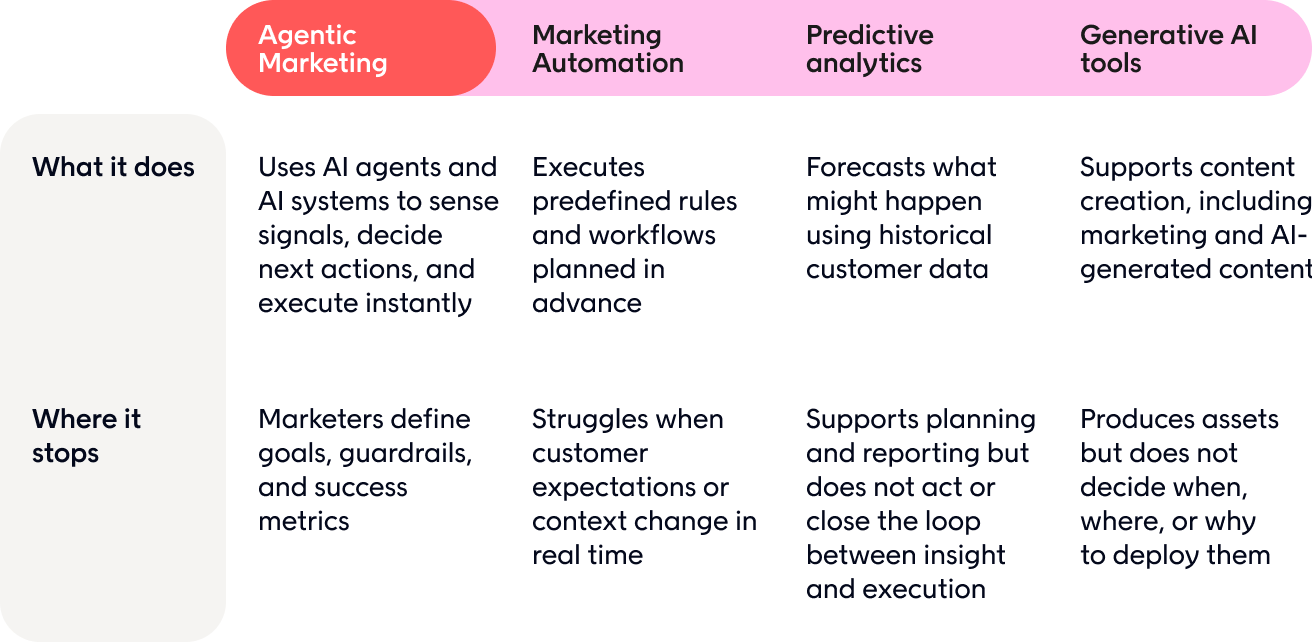
Why this distinction matters for retail teams
Retail marketing moves at the pace of customer behavior. Moments matter, and relevance depends on timing.
When execution depends on traditional automation or manual coordination across tools, teams struggle to keep up.
Agentic marketing changes how work flows, and that shift sets up why agentic AI is especially suited to retail, where complexity, scale, and speed come together.
Why agentic AI is especially powerful for retail marketing
Retail marketing operates in an environment where many variables change at once. Large product ranges, fast buying cycles, and omnichannel customer journeys all shape how customers discover, compare, and buy.
Additionally, loyalty-driven models mean customer relationships are built over time, not through single interactions.
This complexity affects how marketing teams work day-to-day.
Retail teams often manage:
- High SKU counts that influence product discovery and campaign creation
- Multi-channel campaigns that span email, app, web, and in-store touchpoints
- Customer expectations that shift based on availability, timing, and context
Customer behavior changes quickly, and relevance depends on responding at the right moment.
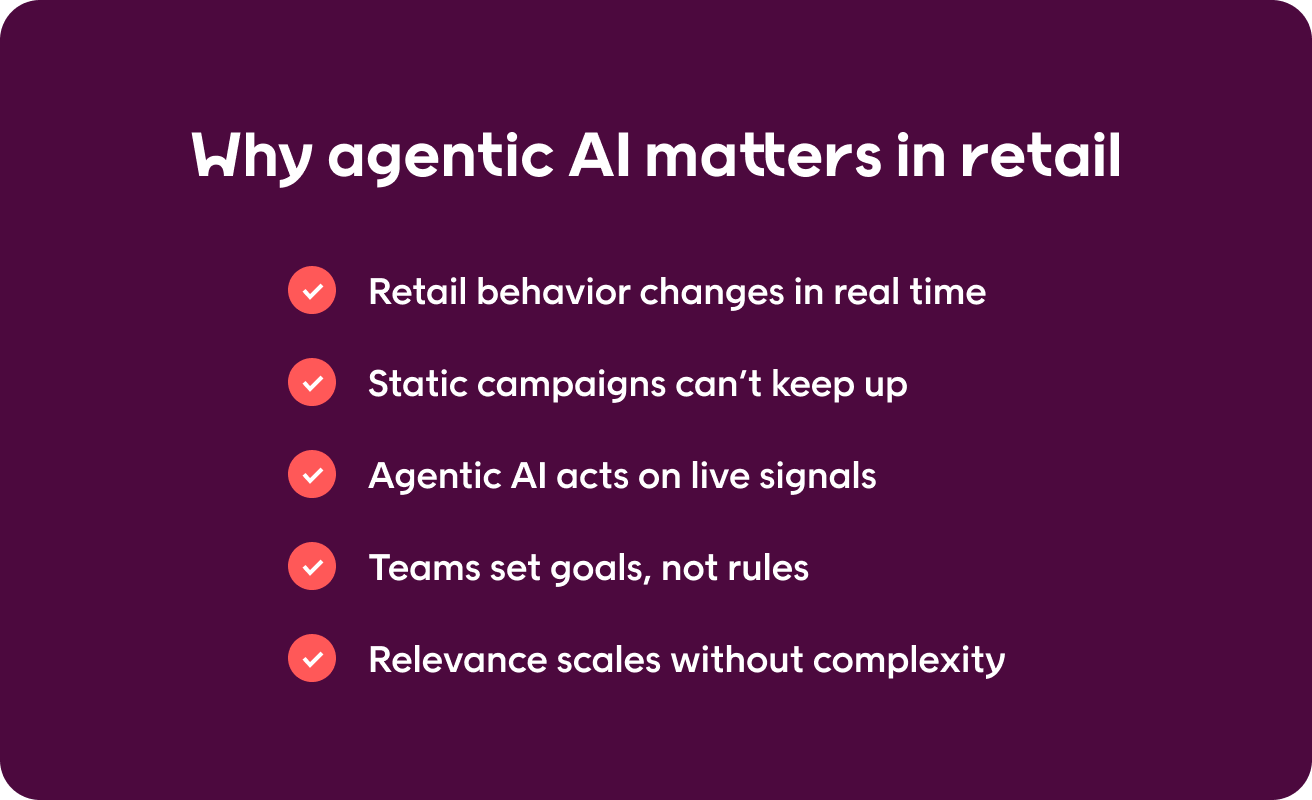
Why static campaigns fall behind
Traditional automation and other automation tools are built around fixed plans. But in retail, customer behavior rarely follows those assumptions.
Pricing changes, inventory levels, and channel context all influence customer interactions in real time. When campaigns cannot adapt, campaign performance suffers, and marketing teams are left reacting instead of acting.
Traditional automation supports scale but not speed.
Agentic AI as a response to operational pressure
Agentic AI systems are designed for environments shaped by constant change. AI agents and other agents monitor signals across the customer journey and respond using real-time customer data, without waiting for manual updates or human intervention.
Instead of managing campaign execution across multiple platforms, marketers define goals, boundaries, and success metrics. AI systems execute within those guardrails, acting instantly as conditions change.
This approach reduces manual work in marketing operations and creates continuous feedback loops between customer data, actions, and outcomes.
What this means for your business
Using agentic AI for marketing helps retail teams:
- Act on customer behavior while it is happening
- Improve customer engagement and customer experiences across channels
- Maintain consistency across campaigns and customer interactions
- Support business growth without adding operational complexity
This shift also changes how teams evaluate AI in marketing. The focus shifts away from isolated AI tools, generative AI, or AI-generated content, and toward systems that can act independently and optimize campaigns in real time.
Platforms like Voyado are built around this need, helping marketing and sales teams turn actionable insights into action across the full customer journey.
That is why agentic AI aligns so closely with retail marketing today, and why it is becoming a competitive advantage as market shifts continue.
From insight to action – how agentic marketing actually works
Agentic marketing works as a continuous loop powered by agentic AI systems.
There is no fixed starting point and no final step.
Marketing begins wherever customers are in the customer journey. As customer behavior changes, the loop keeps moving. This is what allows agentic AI for marketing to act instantly instead of stopping at insights.
The agentic marketing loop
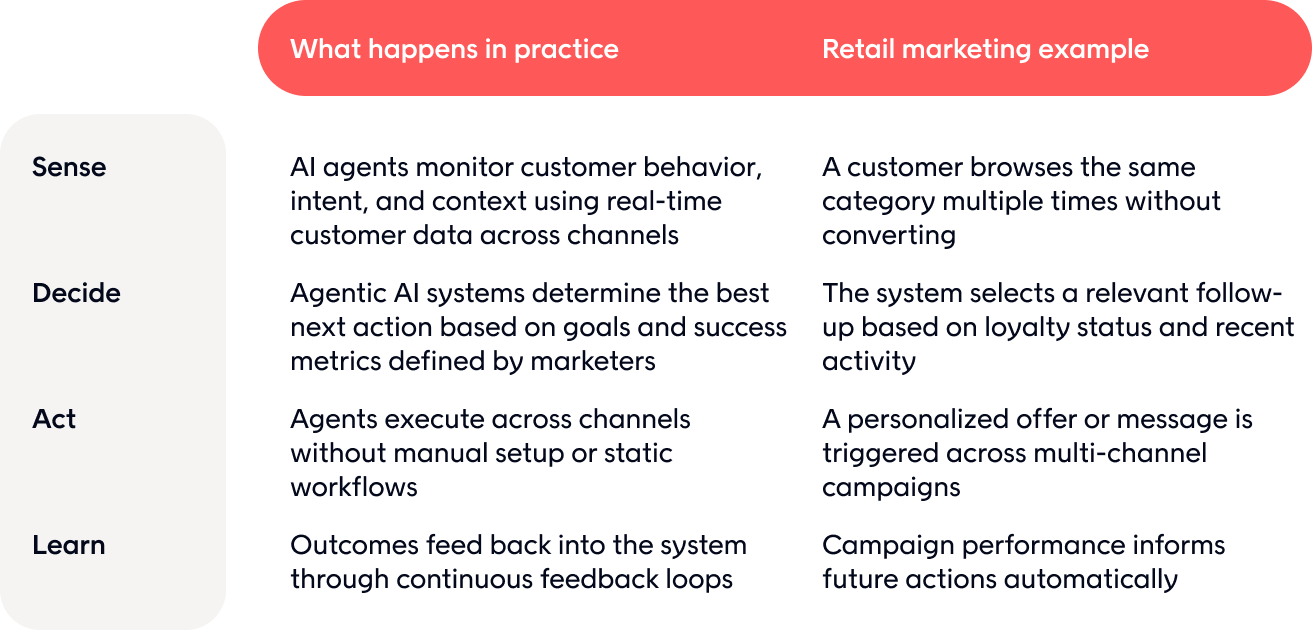
The loop does not reset. Each outcome becomes the next input.
What makes this different from traditional approaches
Traditional automation and traditional AI depend on predefined paths. Static workflows assume campaigns can run as planned.
Customer expectations change with availability, timing, and context. When execution depends on manual work or handoffs between automation tools, relevance drops before campaigns can adjust.
Agentic systems keep decisions and execution inside the same loop, which is why platforms built around a connected view of engagement and loyalty, like a customer loyalty platform, are better suited to this model.
How this shows up in day-to-day retail marketing
For marketing teams, this changes how work moves across platforms.
Instead of managing campaign creation step by step, marketers define strategy, boundaries, and success metrics. AI agents act independently within those guardrails as customer interactions unfold.
This reduces operational load in marketing operations and helps ensure consistency across campaigns, while still allowing human intervention where it adds value.
Because actions are informed by real-time feedback and customer data, teams can optimize campaigns while they are live.
That ongoing motion is what moves marketing from insight to action and makes agentic AI practical for retail at scale.
5 core agentic marketing use cases for retail teams
These use cases show how agentic AI in marketing works in practice. Each one focuses on a concrete retail scenario and the value it delivers.
1. Autonomous customer journey orchestration
This use case is about coordinating actions across the full customer journey in real time.
What this is
AI agents sense customer behavior and context, then decide and act across email, app, onsite, and in-store touchpoints. Journeys are not pre-built or fixed. They adjust as customer interactions change.
Why this matters
Retail journeys are rarely linear. Agentic systems remove the need to constantly rebuild flows, helping marketing teams stay relevant without relying on static workflows or manual updates.
2. Always-on personalization at scale
This use case focuses on delivering relevance without constant maintenance.
What this is
AI agents dynamically adapt content, offers, and recommendations using real-time customer data. Personalization responds to behavior and context instead of static segments.
Why this matters
Manual segmentation does not scale. Always-on personalization supports consistent customer engagement and personalized experiences as campaigns grow, building stronger customer relationships over time. This aligns with how modern retailers approach personalization in retail.
3. Smarter campaign optimization
This use case addresses how campaigns improve while they are live.
What this is
AI agents monitor campaign performance and optimize timing, channel, and message through continuous feedback loops. Adjustments happen automatically across multi-channel campaigns.
Why this matters
Retail teams no longer need to wait for reports to act. Agentic AI for marketing helps optimize campaigns continuously, reducing fatigue and improving results without adding operational work.
4. Loyalty and retention decisioning
This use case centers on protecting long-term value.
What this is
Agentic systems prioritize retention actions based on predicted value and customer behavior. AI agents decide when to trigger incentives, rewards, or reminders and when to hold back.
Why this matters
Smarter decision-making leads to better use of incentives and more sustainable loyalty strategies, strengthening customer engagement without over-discounting.
5. Marketing recovery and intervention
This use case focuses on what happens when engagement drops.
What this is
AI agents detect friction, disengagement, or drop-offs across campaigns and customer interactions, then act instantly to correct course.
Why this matters
Recovery actions protect customer experiences and brand trust. Instead of reacting late, marketing teams can intervene at the right moment as customer expectations shift.
Together, these use cases show how agentic marketing translates into day-to-day execution, helping retail teams keep pace as customer behavior and expectations continue to shift.
What retail marketers need for agentic marketing to work
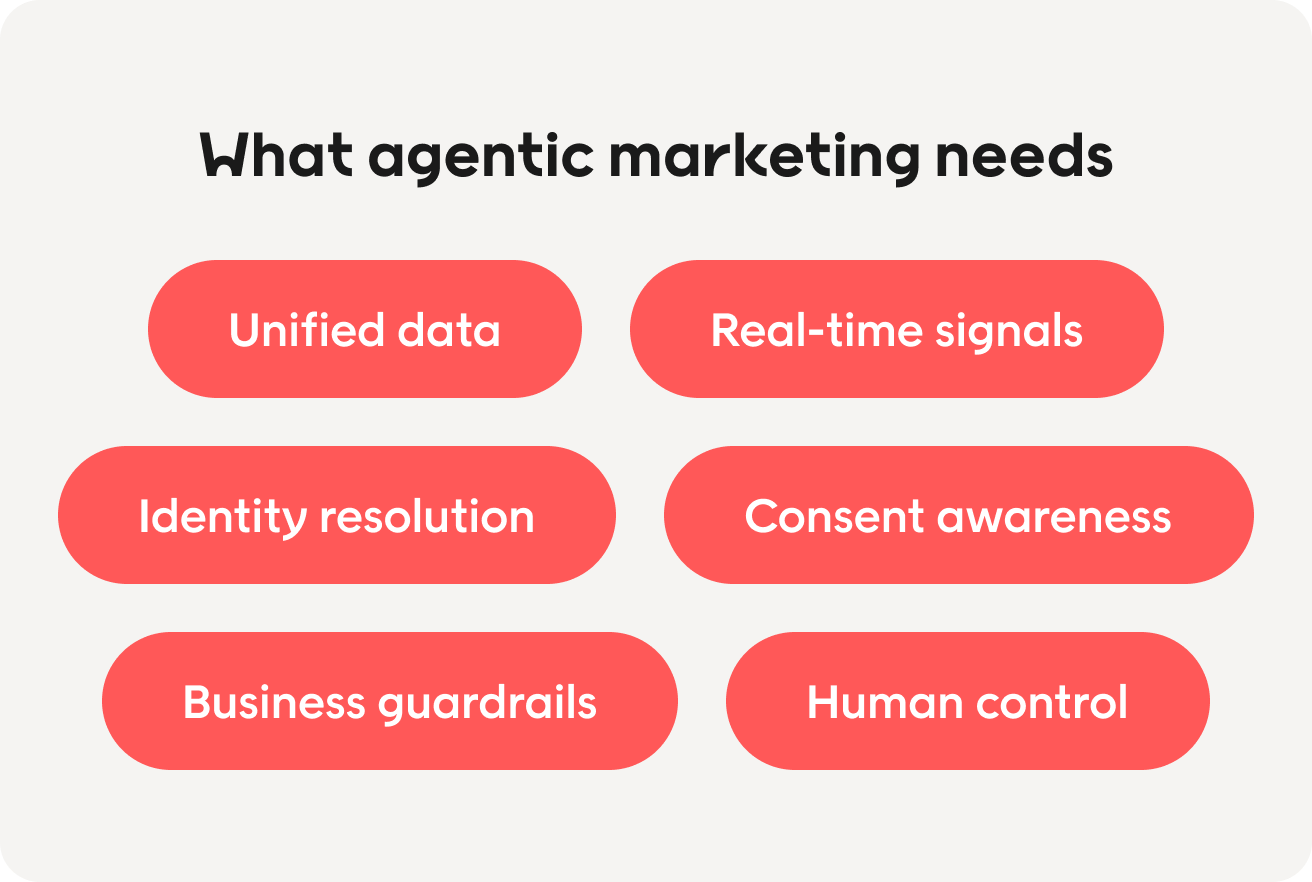
Agentic marketing is only as strong as the foundation beneath it. This is where most early attempts succeed or fail.
Unified customer data
In practice, agentic AI breaks down when customer data is fragmented. When purchases, browsing, loyalty, and engagement live in silos, AI agents act on partial signals. Unified customer data gives agentic systems the full customer journey, so actions reflect reality, not guesses.
Real-time behavioral signals
Timing is everything in retail. Without real-time customer data, decisions arrive late and miss the moment. Teams that rely on delayed signals struggle to meet customer expectations, no matter how advanced the AI appears.
Identity resolution across channels
Retail customers move fluidly between email, app, web, and in-store. When identity resolution is weak, AI treats interactions as separate events. Strong identity resolution connects customer interactions into one continuous journey and prevents contradictory actions across channels.
Consent-aware activation
Speed without control erodes trust. Agentic marketing must operate within consent, preferences, and data privacy rules. This is where many teams hesitate to scale, and where credibility is earned. Consent-aware activation lets AI act instantly without crossing boundaries.
Clear business rules and guardrails
Agentic AI does not replace judgment. Marketers define goals, guardrails, and success metrics. Without clear rules, agentic systems drift. With them, AI supports strategy and reduces manual work while keeping human intervention where it matters.
This foundation is non-negotiable.
Without it, agentic AI creates noise. With it, agentic marketing becomes dependable, scalable, and ready for retail speed.
What agentic marketing is not
Agentic marketing is often misunderstood, especially early on.
- It is not set-and-forget automation.
- It does not replace marketing strategy or strategic thinking.
- It is not a chatbot, a content generator, or a layer of generative AI producing marketing content.
- It is not black-box decisioning that removes control from teams.
Agentic AI works because marketers define intent, priorities, and limits. The system executes within those boundaries, transparently and continuously.
This clarity is what separates mature agentic marketing from experimentation and hype.
How Voyado enables agentic marketing (without losing control)
Voyado’s agentic AI is built as the action layer between insight and execution.
It’s where decisions turn into action, without taking control away from marketing teams.
Built for retail from the start
Agentic marketing only works when AI understands retail context. Voyado is designed around three fundamentals that shape retail decisions every day:
- Retail identity
A unified view of the customer across channels, so actions reflect one continuous customer journey.
- Loyalty economics
Decisions account for long-term customer relationships, not just short-term conversion.
- Omnichannel activation
Actions can be coordinated across channels without stitching together multiple platforms.
This gives agentic AI the context it needs to act responsibly, not blindly.
AI that supports marketers, not replaces them
Voyado’s approach to agentic AI in marketing keeps strategy human-led. Marketers define goals, priorities, and guardrails. AI supports execution inside those boundaries.
As Voyado’s CPO, Felix Kruth, explains:
“What teams are really asking for isn’t more features, but more autonomy. Agentic AI isn’t about replacing marketing teams, but about removing the friction between customer insight and customer action.”
That perspective reflects a broader shift across retail. Agentic AI was a key theme at NRF, where the focus moved from insight generation to autonomous action with control, as explored in Voyado’s take on NRF 2026 trends.
The takeaway for retail marketing teams
Agentic marketing is a mindset shift in how marketing work gets done, not a tool swap for your teams.
The move is away from collecting more insight and toward enabling action at the right moment. That shift changes what teams prioritize and how they evaluate platforms.
Winning retail teams will:
- Focus on outcomes, not dashboards
Success is measured by what changes for customers and the business, not by how many insights are produced.
- Design for action, not analysis
Marketing systems need to decide and act in real time, without waiting for manual follow-up.
- Choose platforms built for retail reality
Retail complexity demands tools that understand identity, loyalty, and omnichannel execution from the start.
Agentic marketing raises the bar and asks your teams to think less about reporting and more about readiness to act.
If you’re exploring how agentic marketing could work for your retail organization, seeing it in context matters. A short walkthrough can help you understand what becomes possible when insight, decisioning, and action work together in real time.
Book a demo to explore how agentic AI can support your teams, customers, and growth goals.
FAQs
What is agentic AI for marketing?
Agentic AI for marketing uses AI agents to decide and execute marketing actions autonomously, based on goals and real-time context. Instead of only generating insights, it acts across the customer journey as customer behavior changes.
How is agentic marketing different from automation?
Traditional automation follows predefined rules and static workflows. Agentic marketing continuously senses, decides, and acts, adapting actions in real time rather than executing fixed plans.
Is agentic marketing safe and compliant?
Yes, when implemented correctly. Agentic marketing operates within consent, data privacy requirements, and business rules defined by marketers, ensuring actions remain controlled and compliant.
Do retailers need a CDP for agentic marketing?
Retailers need unified, accessible customer data, but not every setup requires a standalone CDP. What matters is having reliable customer identity, real-time signals, and governance in place.
How can marketing teams stay in control?
Marketing teams stay in control by defining goals, guardrails, and success metrics. Agentic AI executes within those boundaries, with human intervention available where judgment or oversight is required.