95% of retailers use AI. Only 5% see ROI. Read the report →
Profile of a leader

What does AI maturity look like?

What separates the 5% from the rest? Advanced retailers don’t simply use more AI tools. They integrate AI more deeply into their operating model. Their advantage is structural, and the research points to three consistent patterns.
AI is embedded in commercial decision-making, not just campaigns
Integration depth

AI is embedded in commercial decision-making, not just campaigns

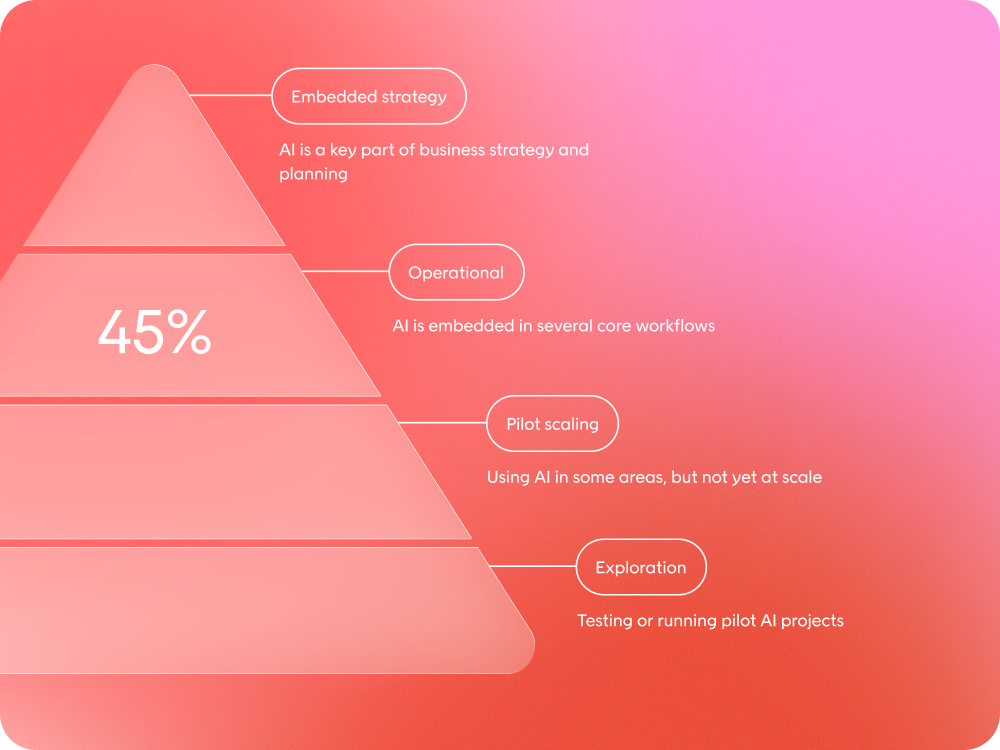
Across European retail, 45% of retailers report operational AI, where AI supports defined workflows such as campaign optimization, product discovery, pricing, or CRM execution.

What separates more advanced organizations is how early AI enters the decision process. In mid-stage organizations, AI improves execution within specific channels. In more mature organizations, it informs planning, prioritization, and commercial trade-offs across functions.

Only a small minority reach continuous, feedback-driven optimization, where performance data feeds directly back into future decisions.

The difference isn’t whether retailers use AI, but where in the organization it operates.

AI leaders in retail use 2x more data sources
Data breadth

Customer, product, and performance data work together

Retailers operating at advanced stages draw on nearly twice as many data sources as those at more basic levels. This reinforces a structural truth: maturity is built over time through data foundation development, rather than enabled by a single technology choice.

In mid-stage organizations, data often sits in separate systems: CRM, e-commerce platforms, loyalty programs, media tools, and inventory systems operate in parallel. AI can optimize within those environments, but its impact remains limited by disconnected data.

In more mature organizations, customer behavior, product information, inventory, pricing, and performance data are connected. This broader data environment allows AI systems to operate with greater context.

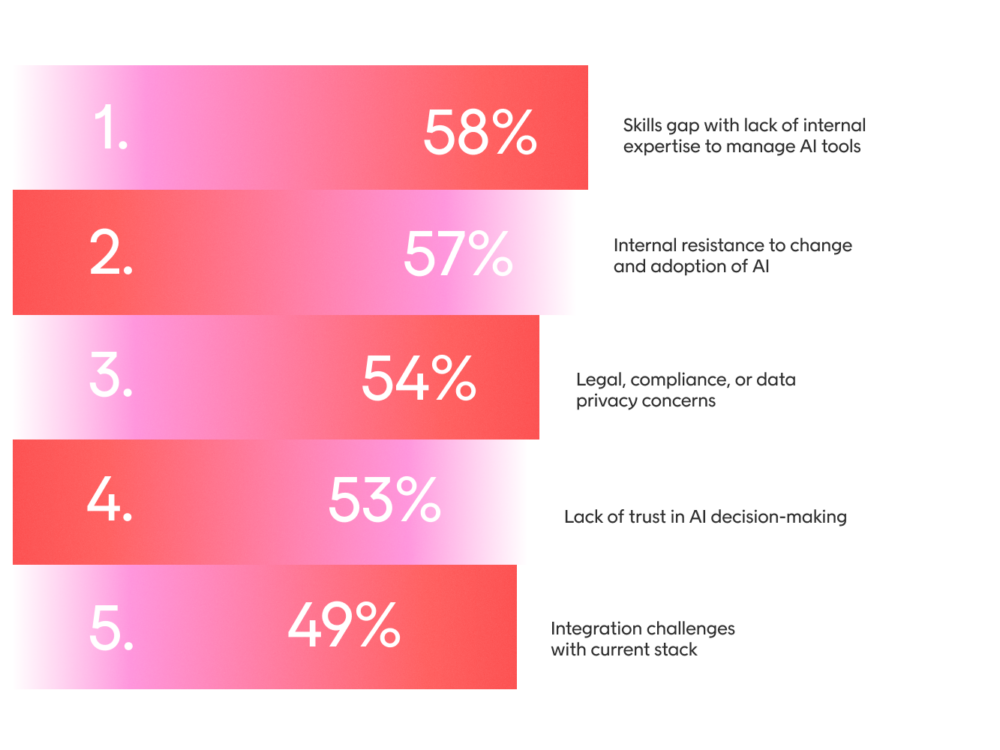
Top 5 barriers to advancing AI in retail_png
Organizational readiness

AI is supported by clear ownership and skills

With 58% of retailers citing skills gaps as a primary barrier, alongside concerns around governance, trust, and accountability, access to tools is rarely the constraint. The real challenge is organizational capability.

In many mid-stage organizations, AI initiatives are spread across teams without clear ownership. Marketing and e-commerce operate independently, vendors manage optimization logic, and internal teams often lack the expertise to evaluate models or embed AI into commercial planning. As a result, automation remains cautious and contained.

More mature organizations address this deliberately. They establish clear ownership of AI-driven outcomes, build internal capability to manage and optimize AI systems, and create governance frameworks that enable rather than restrict automation. Leaders invest in skills alongside systems, building the internal fluency needed to measure performance, refine models, and apply human oversight effectively.

 

What separates leaders

Across the retailers that achieve measurable impact from AI, the pattern is consistent. Progress doesn’t come from adopting more tools, but from embedding AI into how the organization operates. This shifts the focus from individual productivity to measurable business outcomes.

Where AI informs planning, operates on unified data, and is supported by internal capability, performance compounds. Where one of these elements is missing, AI may still be active, but impact remains limited and scale elusive.

download_report_bg_state of AI in retail download_report_bg_state of AI in retail

Download the full report

Access the full research from Voyado and Retail Economics to discover what separates leaders from the rest.